He online marketing It allows you to attract an audience, generate leads, and increase sales through internet-connected channels. But posting on social media or running ads isn't enough. For an investment to work, I need to start with a clear business objective, choose channels based on user intent, and measure results with realistic criteria.

Table of Contents
- What Should an Online Marketing Strategy Solve?
- Channels According to User Intent
- Measurement, Privacy, and Profitability
- Key Takeaways
- Frequently Asked Questions About Online Marketing
What Should an Online Marketing Strategy Solve?
Online marketing encompasses the promotional, acquisition, retention, and analytical activities carried out through websites, search engines, email, social media, advertising platforms, and other connected channels. Online advertising is only one part: it involves paying for visibility or clicks. Online marketing also includes SEO, content, automation, website experience, analytics, branding, and database management.
This distinction matters because a company can spend on PPC and get clicks without building its own assets. It can also publish content for months without a clear path to conversion. A balanced strategy bridges both extremes: immediate acquisition and sustainable growth.
I wouldn't start by asking which social network is trending. I would start by defining what profitable action the visitor should take: request a quote, book an appointment, make a purchase, download a guide, or request a demo.
Define the Objective Before the Channel
A useful objective should express an action, a target audience, and a financial reference point. “Gaining visibility” might be a valid objective for a new brand, but it's insufficient for budget management. It's better to be specific: “Gain quote requests from service companies in Madrid” or “Increase online sales in a specific category.”
To organize it, I can separate the objectives into three levels:
• Visibility: Increase qualified reach, brand searches, useful plays, or traffic to relevant content.
• Consideration: to get recurring visits, subscriptions, downloads, product comparisons or interaction with valuable resources.
• Conversion: Generate sales, validated forms, calls, bookings, business meetings, or quote requests.
Each level requires a different metric. A video can perform well for visibility but not generate direct sales. That doesn't automatically make it a failure; it would be a mistake to judge it using the same metric as a purchase-oriented search campaign.
Build an Offer That the User Understands
A good campaign can't compensate for a confusing message. If someone searches for "urgent WordPress maintenance" and lands on a page that only says "innovative digital solutions," there's too big a gap between their problem and the message.
The proposal must quickly answer four questions:
- What problem is being solved?
- Who is the solution for?
- What outcome or process can that person expect?
- What should he do now?
For example, a professional firm doesn't necessarily need a campaign with thousands of visits. It might need less traffic, but a page that explains the service, clarifies service areas, shows the contact process, and answers questions before booking an appointment is sufficient.
Here, the website ceases to be a brochure and becomes an active part of the sales process. Web design adapted for digital marketing This is especially relevant because a large portion of visits come from mobile devices. If the page is slow, requires users to expand the text, or is difficult to complete, the advertising budget could end up funding abandoned users.
Choosing a Realistic Recruitment Model
Not all businesses should pursue the same sales funnel. The decision depends on price, timing of purchase, the need for trust, and purchase frequency.
| Type of Business | Usual Priority | Recommended Conversion Action | Frequent Risk |
|---|---|---|---|
| E-commerce | Product, price and availability | Shop online | Measure only revenue without deducting margin, returns, and advertising costs |
| Local service | Proximity and speed of response | Call, reservation or form | Send traffic to a generic page with no location or times specified. |
| B2B Service | Trust and explanation | Request for meeting or diagnosis | Asking for an immediate sale when the decision takes weeks |
| Training or subscription | Content and proof of value | Registration, demo or download | Treat all records as if they were of the same quality |
My recommendation is to also define what happens after the conversion. If a form takes three days to receive a response, the problem isn't solely with marketing. Coordination with sales, customer service, and operations determines how much value each lead generates.
Channels According to User Intent
SEO, SEM, social media, email, and content marketing don't always compete with each other. They serve different purposes. Choosing them based on popularity often scatters the budget; choosing them based on intent helps create a coherent system.
Advertising concentration in Spain reinforces the need to think carefully. The study of the CNMC on online advertising in Spain It noted that the market reached approximately €3.45 billion in 2019, with search and display as the largest segments and a high concentration on platforms. Google accounted for more than 50% of total online advertising revenue during the period analyzed, while Facebook exceeded 20%.
This doesn't mean you should avoid Google Ads or Meta Ads. It means that relying entirely on a single platform can leave a business vulnerable to changes in costs, rules, algorithms, or audience availability.
SEO and Content Marketing for Sustained Demand
SEO improves organic search engine presence. It works best when there is a clear demand and a website can provide a useful, technical, or commercially compelling answer. It doesn't guarantee immediate results, but it creates cumulative assets: service pages, help content, local listings, comparisons, and resources that remain useful over time.
SEO is a good choice when:
• People are already looking for the product, service, or problem.
• The business can create specific pages and keep them updated.
• There is room to wait and continuously improve.
• The website allows for a good technical experience, especially on mobile.
It's best to avoid treating it as the sole channel when you need a high volume of leads in just a few days, are launching a limited-time offer, or the site doesn't yet clearly explain what it sells. In those cases, SEO can work in parallel with paid campaigns.
Content marketing offers more than just informative articles. A calculator, a buying guide, a frequently asked questions page, or a comparison chart can address real objections. That's why reviewing and adjusting the online marketing strategies It should be a routine: content with visits but no progress towards action may need a clearer call to action, a better offer, or a different search intent.
SEM, PPC and High-Intent Advertising
In practice, SEM usually refers to search engine advertising campaigns. The PPC model allows you to pay per click, although the actual cost of acquiring a customer depends on the entire journey: ad, keyword, landing page, form, sales follow-up, and closing.
A search campaign is usually effective when someone expresses a specific need. “Inheritance lawyer Barcelona”, “invoicing software for freelancers” or “buy ergonomic chair” show different signals, but all can indicate commercial intent.
The mechanics are simple on the surface: you select search terms, set a bid, and create an ad. Beneath the surface, performance depends on the balance between four elements:
- Consultation: what the person actually writes.
- Advertisement: the promise and the filter it presents.
- Landing page: the page that confirms and develops that promise.
- Conversion: the measured action and its subsequent quality.
A common mistake is buying keywords that are too broad. A clinic bidding on “back pain” might attract informational inquiries when it's actually looking for patients for a specific treatment. The solution could include more precise keywords, excluding irrelevant searches, and creating dedicated pages for each service.
Social Media, Display and Email to Build Relationships
Social media and display advertising are useful for building awareness, showcasing visual products, amplifying content, and re-engaging audiences already familiar with a brand. However, interaction does not equate to purchase intent. An ad with many "likes" may have little commercial relevance.
Email marketing, on the other hand, works with people who have already given permission or begun a relationship. It can inform, recover abandoned shopping carts, educate, renew services, and support long decision-making processes. Its value increases when segmentation is based on first-party data: stated interest, viewed product, purchase history, or stage of relationship.
The Importance of the database in marketing It grows precisely because it allows for a reduction in dependence on audiences rented from external platforms. It's not about accumulating contacts without any strategy. It's about having legitimately obtained, organized, and useful data to deliver relevant communications.
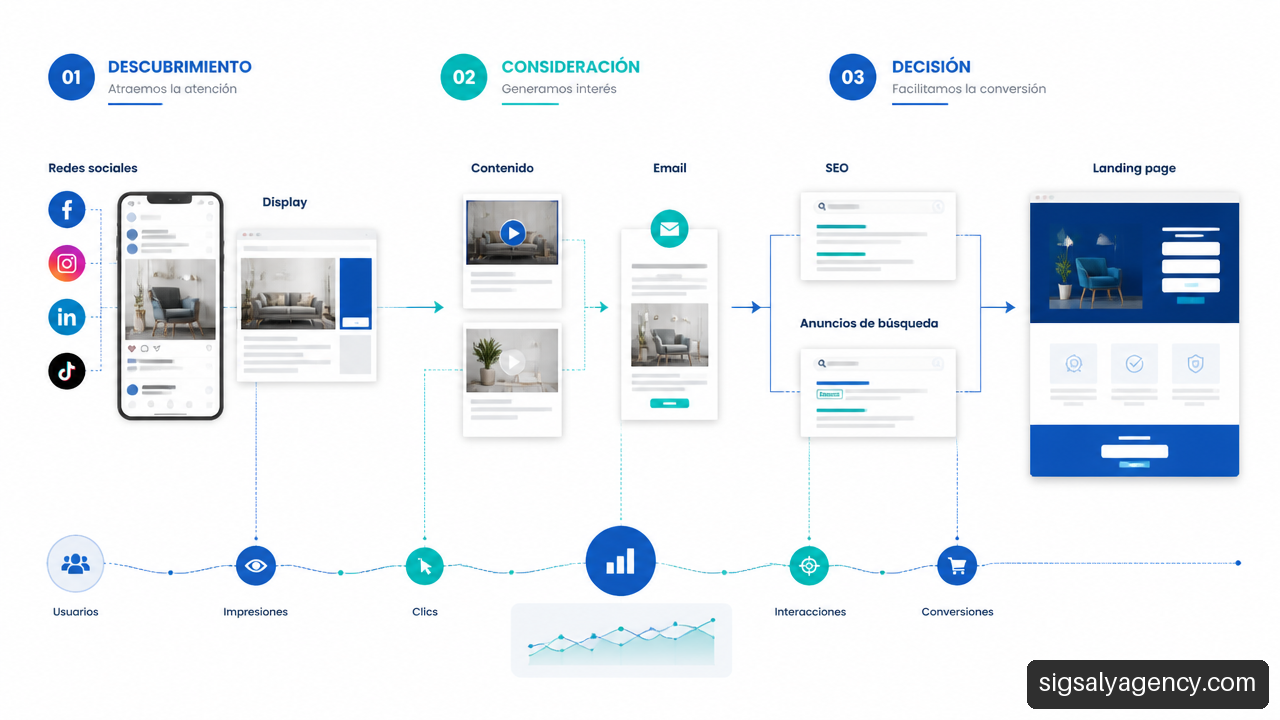
| Intention Stage | Most Suitable Channels | Main Message | Initial Metric |
|---|---|---|---|
| Discovery | Social media, display, video, content | Problem, need, or category | Qualified reach, new visits, reproduction |
| Consideration | Informational SEO, email, remarketing, comparisons | Method, test, differences, and use cases | Registration, recurring visit, download |
| Decision | Transactional SEO, SEM, segmented email | Offer, availability, price or contact | Sale, valid lead, CPA, ROAS |
Measurement, Privacy, and Profitability
The great advantage of online marketing is that it allows you to measure many interactions. The challenge lies in interpreting those measurements without confusing activity with results. A dashboard full of graphs doesn't guarantee better decisions.
The CNMC's explanation of online advertising figures It indicated that the Spanish market was growing by around 20% annually during the period studied and that Google and Facebook accounted for more than 70% of online advertising revenue. The practical implication is clear: these platforms can be very effective, but it's advisable to protect your business with SEO, your own database, content, and measurement that doesn't depend on a single interface.
Measure the Entire Journey, Not Just the Click
To begin, I would choose a small set of interconnected metrics:
• Qualified traffic: visits from people with a relevant intention.
• Conversion rate: percentage of visits that perform the target action.
• CPA: cost per acquisition or per valid lead.
• ROAS: revenue attributed for each euro invested in advertising.
• Customer value: revenue and margin generated after the first conversion.
ROAS can be misleading if margins aren't taken into account. A business might bill €500 for a campaign that cost €100 and show a ROAS of 5. However, if margins are low, there are logistical costs, and returns occur, the profit may be limited. For an SME, an acceptable CPA should be based on margin and the actual probability of closing a sale, not a standard percentage.
Cookies, Consent and Own Data
Privacy must be integrated into campaign design from the outset. In Spain and the European Union, the GDPR, the LOPDGDD, and applicable cookie regulations require processing personal data with an appropriate legal basis and obtaining consent where necessary for non-essential technologies. Marketing communications must also be clearly identified as such and comply with applicable requirements.
This directly impacts analytics, remarketing, and audience creation. If someone rejects marketing cookies, they shouldn't be added to certain advertising tracking lists. If consent is incomplete, the figures may be incomplete or inconsistent.
The answer is neither to ignore the problem nor to promise perfect attribution. It's to combine several layers:
- Set up a consent management platform that clearly records preferences.
- Tag campaigns with consistent UTM parameters to recognize sources and messages.
- Connect analytics data with CRM and sales, where possible and in accordance with regulations.
- Review modeled or estimated conversions as signals, not as absolute truths.
- Compare trends by period, channel, and commercial quality of contacts.
Fair warning: a drop in recorded conversions doesn't always mean a corresponding drop in sales. It could be due to a technical change, invalid consents, or a broken tag. That's why I need to cross-reference the advertising platform, analytics, CRM, and actual sales before stopping a profitable campaign.
Mistakes That Usually Waste Budget
Performance problems often arise from the accumulation of minor issues. These are the most common ones and how to fix them:
| Mistake | What Happens | How to Fix It |
|---|---|---|
| Send all traffic to the homepage | The user must find the answer on their own. | Create landing pages by service, campaign, or intent |
| Optimize only for cheap clicks | Uninterested traffic arrives | Review conversions, lead quality, and search terms |
| Measuring forms without validating sales | Quantity is confused with real opportunity | Mark accepted, lost, and converted leads in CRM |
| Relying on a platform | A change in cost disrupts the entire plan | Diversify with SEO, email, content, and your own data |
| Ignoring consent and labeling | Data is missing or collected incorrectly | Audit cookies, tags, events, and legal notices |
Key Takeaways
• Online marketing combines acquisition, content, web, data, and loyalty; advertising is just one piece.
• The choice of channels should depend on the user's intent and the buying cycle, not on the popularity of a platform.
• SEO builds visibility in the medium and long term; SEM can capture active demand more quickly, but requires cost control and relevance.
• The landing page, website speed, and sales tracking have as much influence as the advertisement on the final result.
• CPA, ROAS and actual sales provide more context than impressions, clicks or followers.
• Privacy limits some measurement and remarketing, so first-party data and CRM are strategic assets.
• Diversifying reduces the risk of being completely dependent on Google, Meta, or another advertising platform.
Frequently Asked Questions About Online Marketing
What is Online Marketing?
It's the set of actions used to promote a brand, product, or service online. This includes SEO, SEM, PPC, social media, email marketing, content creation, web design, analytics, and automation. Its objective can be to increase brand awareness, generate leads, make sales, or build customer loyalty.
What is the difference between online marketing and online advertising?
Online advertising involves paying for ad space, impressions, clicks, or results on digital platforms. Online marketing is broader: it includes advertising, but also strategy, content, website experience, organic search engine optimization, data, and customer management.
How much budget is needed to get started?
There's no single, universally applicable figure. It depends on the industry, the product's price, the competition, and the objective. A local business might launch a controlled test in a specific geographic area with a targeted offer. A B2B business with high-value sales might accept a higher CPA if the closing rate and margin justify the investment. Before scaling, it's essential to validate that the landing page, metrics, and sales process are effective.
How Long Does SEO Take vs. SEM?
SEM can generate visits and conversions from the moment a campaign is approved, although it doesn't guarantee profitability. SEO typically requires more time because it depends on technical improvements, content, relevance, and competition. As a general guideline, SEO should be evaluated over months, not days; SEM allows for faster learning, but can quickly become expensive in competitive sectors.
What's Better: SEO, SEM, Social Media, or Email Marketing?
There's no single winner. SEO works well for recurring demand; SEM is useful for high-intent searches and quick tests; social media is good for discovery and visual audiences; email helps nurture and retain customers. The best combination depends on where your audience is and what they need before you decide.
How Do I Know If a Campaign Is Working?
It's essential to compare cost with value generated. For direct sales, review revenue, margin, CPA, and ROAS. For services, check how many leads convert into opportunities and sales. It's also helpful to compare equivalent periods and monitor changes in quality, not just volume.
How do cookies affect online marketing?
Cookies and other tracking technologies may require consent. If some visitors do not consent, certain conversions and remarketing audiences will not be recorded in the same way. This necessitates using first-party data, UTMs, CRM, and trend analysis to make more contextualized decisions.
What Mistakes Cause You to Lose the Most Money?
The most costly mistakes are usually buying traffic without a clear offer, sending ads to generic pages, not filtering irrelevant searches, measuring leads without verifying their quality, and relying on a single platform. Correcting these issues often yields more benefits than simply increasing the budget immediately.
Sources and References
• CNMC — The CNMC publishes a study on the online advertising sector in Spain