Designing a digital platform for a brick-and-mortar business requires going beyond mere corporate aesthetics. When a customer searches for a dental clinic, restaurant, auto repair shop, or specialty store, their ultimate goal isn't to spend hours browsing a website, but rather to resolve a practical need: to find out if the establishment has what they're looking for, check opening hours, calculate directions, or book an appointment. In this context, an online presence acts as a direct bridge between the digital environment and in-person traffic to the physical location.
Table of Contents
• Key Points on Local Web Design
• Strategic Principles of Web Design for Physical Stores
• Content Architecture and Data Governance NAP
• Local Conversion and User Experience on Mobile Devices
• Structured Data and Technical SEO for Businesses
• Measurement and Attribution of In-Person Traffic
• Frequently Asked Questions about Local Web Design
Key Points on Local Web Design
• Priority operational objectiveThe website of a physical establishment should be geared towards generating measurable actions in the real world, such as phone calls, requests for directions, appointment bookings and face-to-face consultations.
• Data Synchronization (NAP)The name, address, and phone number must be identical on the website, Google Business Profile, and industry directories to avoid discrepancies that confuse customers and search engines.
• Actual capacity management: Web contact and booking systems must be aligned with the operational capacity of the premises and opening hours to avoid saturation or poor in-person service.
• Architecture by locationFor companies with multiple points of sale or service, it is essential to design separate pages for each location that contain unique geographic information and specific structured data.
• Measurement adapted to the physical environmentWeb analytics should configure events to measure map clicks, phone interactions, arrival guide downloads, and appointment booking forms.
Strategic Principles of Web Design for Physical Stores
The digital approach for a business with a physical location differs significantly from the model of a pure e-commerce site or a content portal. In our strategic practice, we observe that design decisions must respond to the time and mobility constraints of local users.
From Online Visibility to In-Person Visit
Digital design focused on local commerce aims to transform website visitors into passersby or customers within the establishment. To achieve this, the user interface must eliminate any friction within the first three seconds of navigation. A user searching from their mobile device while walking or driving requires instant answers.
| Interface Element | Role in Physical Business | Impact on User Experience |
|---|---|---|
| "How to get there" button | Open your preferred map application with the calculated route | Eliminates the need to copy and paste the address |
| Live opening hours | It shows whether the business is open, closed, or about to close. | Avoid unnecessary customer travel. |
| Direct call button | Start a call with a single tap from your mobile phone. | Facilitates last-minute availability inquiries |
| Quick appointment form | Request only the minimum necessary data | Accelerate conversion without overwhelming phone lines |
Critical information should not be hidden in complex drop-down menus. When planning a service web development and design with WordPressWe prioritize placing the exact address, updated hours, and direct contact buttons at the top of the main screen.
The Role of the Web Compared to Google's Business Profile
It's common to wonder if a business needs a website if it already has an active listing on Google Maps and a Google Business Profile. The reality is that these two assets are complementary and reinforce each other. Google can gather information about a business through its official website, data provided by owners, users, and other public sources. Therefore, discrepancies between channels can negatively impact the business's online presence.
The listing on the maps acts as the first point of discovery in geolocated searches. However, the official website represents the brand's complete control space, where it's possible to explore the service catalog in depth, showcase facilities with high-resolution photographs, explain work protocols, and collect data through proprietary booking systems.
Mobile Prioritization for Users on the Move
Over 70% of searches related to local businesses are made from mobile devices. This means that responsive design or responsive It's not an optional extra, but the core of the technical development. The design must allow for one-handed use, placing interactive elements in areas easily accessible with the thumb.
- Large pulse zones: The buttons must have a minimum surface area of 48×48 pixels to avoid accidental touches.
- Priority loading speedImage optimization and deferred resource loading are vital for users with unstable mobile data connections.
- Simplified visual hierarchyThe text should be legible without needing to enlarge the screen, using fonts with good contrast against the background.
Content Architecture and Data Governance NAP
Data governance in local web design demands absolute consistency between what is published online and what exists in the physical world. The acronym NAP (Name, Address, and Telephone) defines the essential triangle of local identity.
Creating a Single Source of Truth for Local Data
To avoid information discrepancies across multiple platforms, the official website should serve as the single source of truth for the business. Any changes to phone numbers, location relocations, or service updates should first be implemented on the website and then immediately shared on map profiles, social media, and industry platforms.
+———————————————————-+
| OFFICIAL BUSINESS WEBSITE |
| (Single Source of Truth – NAP) |
+—————————+————————–+
|
+——————–+———————–+
| | |
vvv
+———–+ +———–+ +———–+
| Profile | | Networks | |Directories|
| Google | | Social | |Sectoral|
+———–+ +———–+ +———–+
When search engines detect that a name or web address doesn't match public records or map profiles, algorithmic trust in the entity decreases. This can reduce visibility in local search results.
Management of Special Schedules and Holiday Closures
One of the weaknesses of many local websites is their lack of updates during holidays, vacations, or special events. A customer who travels to a business based on online hours that turn out to be inaccurate experiences frustration that is difficult to remedy.
We recommend integrating a time management module into the web structure that allows you to define:
• Usual opening hours: Specified by days of the week and morning and afternoon shifts.
• Calendar of local and national holidays: With visible alerts at the top during the weeks leading up to the holiday.
• Closures for holidays or renovationsWith a clear message indicating the exact reopening date and alternative service channels.
• Different schedules by service: In businesses such as restaurants with home delivery service or clinics with emergency care outside of consultation hours.
Multi-site Business Website Strategy
If a company has multiple branches, clinics, or stores, it's a tactical error to concentrate all the information on a single general contact page. Each location requires a dedicated page within the website's architecture.
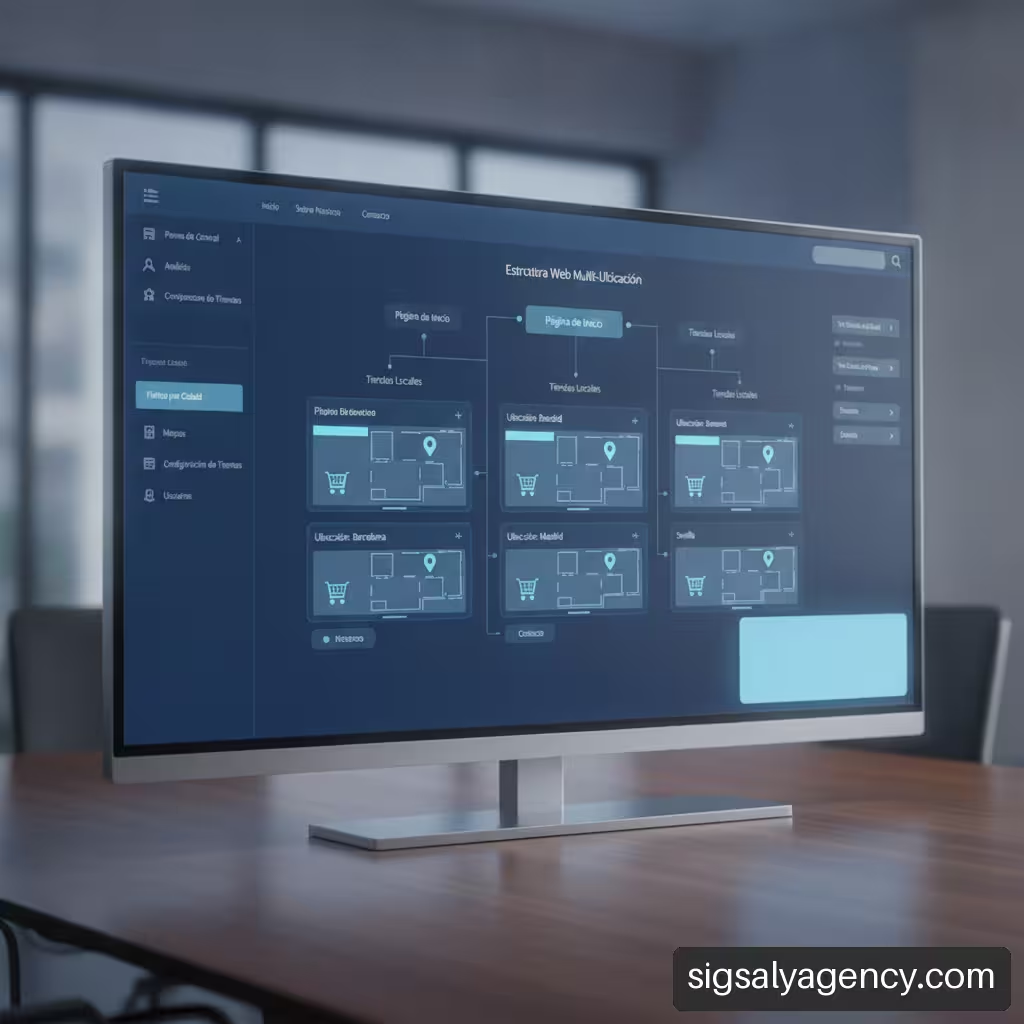
To delve deeper into holistic organic growth, we combine visual development with strategies of web design online marketing and mcp to improve your positioning, ensuring that local pages rank optimally.
Each site page must include:
- Name of the physical location: Clear headline specifying the neighborhood, city, or commercial area.
- Full address and interactive map embedded: With precise geographic coordinates.
- Telephone and email of the specific headquartersAvoiding forwarding all calls to a centralized number if local staff are answering.
- Photo gallery of the team and facilities at that headquarters: Avoiding the use of generic stock photographs.
- Specific access instructionsWhere to park, nearby public transport and accessibility for people with reduced mobility.
Local Conversion and User Experience on Mobile Devices
Conversion rates on a brick-and-mortar store's website aren't always measured in immediate online financial transactions. In most cases, conversion takes the form of an interaction that precedes an in-person visit.
Selection of Direct Contact Channels
Offering too many channels or choosing the wrong ones can fragment the reception team's attention. It's essential to select the contact methods that best suit the establishment's workflow.
• Traditional telephone callsIdeal for emergencies or immediate confirmations (e.g., locksmiths, emergency veterinary clinics or workshops).
• Instant messaging applications (like WhatsApp): Very effective for asking specific questions about products in stock, although they require clearly defining a message response time.
• Appointment request formsPerfect for services that require advance booking (consulting firms, beauty centers, professional offices).
• Route on interactive map: Essential for retail businesses (retail) where the client does not usually give notice before arriving.
Integration of Online Booking and Actual Venue Capacity
A common operational problem arises when the website accepts more bookings than the physical establishment can handle. To prevent this mismatch, the online booking tool integrated into the website must synchronize in real time with the business's management software or calendar.
When proposing these types of integrated solutions, it is key to rely on a service of Professional web design including support and maintenance with content development to adjust the booking rules and avoid overselling appointments or places.
Accessibility Applied to Visit Tasks
Web accessibility is not only a legal requirement in many regulatory frameworks; it is also a decisive factor for anyone to be able to plan their visit to the premises. The design must ensure that people with visual, hearing, or motor disabilities can find access information without barriers.
| Accessibility Criteria | Local Web Application | Direct Benefit |
|---|---|---|
| Alternative text in images | Syntactic description of the entrances and ramps of the premises | It allows screen readers to inform people with visual impairments |
| High contrast marking | Call buttons and visual maps legible in sunlight | Facilitates viewing on a mobile screen outdoors |
| Textual alternative to the telephone | Forms legible for people with hearing disabilities | It allows you to book without making a voice call |
| Clear iconography of physical accessibility | Visual indicators of elevator, ramp or adapted bathroom | Inform wheelchair or stroller users in advance |
Structured Data and Technical SEO for Businesses
Local SEO relies heavily on how data is transmitted to search engines. Search engines use structured data markup to accurately understand a website's business nature and location.
Correct Implementation of LocalBusiness Marking
The Schema.org vocabulary provides the type LocalBusinesswhich can specialize in subtypes such as MedicalBusiness, Restaurant, Automotive Business either Financial ServiceAccording to Google Search Central documentation, structured markup LocalBusiness You can describe properties such as the physical address of the business and must reflect real and verifiable information on the page.
It is important to highlight a crucial technical aspect: the marking LocalBusiness It helps Google understand business data, but its main function is to communicate structured information and does not in itself constitute a guarantee of priority local ranking.
A basic fragment in JSON-LD format for a physical location should be structured as follows:
{
"@context": "https://schema.org",
"@type": "LocalBusiness",
«name»: «Establishment Name»,
"image": "https://example.com/photos/facade.jpg",
«@id»: «https://example.com/#localbusiness",
"url": "https://example.com",
"telephone": "+34912345678",
"address": {
"@type": "PostalAddress",
«streetAddress»: «Main Street 123»,
«addressLocality»: «City»,
"postalCode": "28001",
"addressCountry": "ES"
},
"geo": {
"@type": "GeoCoordinates",
"latitude": 40.416775,
"longitude": -3.703790
},
«openingHoursSpecification»: [
{
"@type": "OpeningHoursSpecification",
"dayOfWeek": [
"Monday",
"Tuesday",
"Wednesday",
"Thursday",
"Friday"
],
"opens": "09:00",
"closes": "19:00"
}
]
}
Synchronization between Google Search, Maps and the Web
Claiming and verifying a Business Profile allows you to manage the address, contact information, primary category, and photos displayed on Google Search and Google Maps. The official website serves as explicit evidence of your company's identity to Google.
Furthermore, structured information maintained on the web should not be blocked by directives in the file robots.txt, labels noindex or login requirements or paywalls. Search engine crawlers need free access to the source code to process the declared data.
Validation and Technical Traceability with Official Tools
Before considering the deployment of markup on a local website complete, it is essential to validate the syntax of the organization and location data. Google Search Central indicates that structured data should be validated with the Rich Results Testing tool (Rich Results Test) and be verified using the URL inspection function (URL Inspection) in Google Search Console before generalizing its implementation.
- Enhanced results test: Allows you to check if the JSON-LD code syntax is free of syntax errors or omitted mandatory properties.
- URL Inspection Tool: Ensures that the page is rendered correctly by Google's crawler and that the markup is visible in the final DOM.
- Verification of website indexing: Ensures that each physical location has a properly indexed individual URL.
Measurement and Attribution of In-Person Traffic
Determining the return on investment (ROI) of a website targeting physical stores requires properly configuring digital analytics. Since the final sale often occurs at the checkout or counter, the website must measure the micro-conversions that precede such a visit.
Local Conversion Events in Web Analytics
To rigorously evaluate website performance, we configured custom events in our analytics tools. These events record intentional actions that demonstrate a clear interest in visiting the facilities.
• Click on the address link / "How to get there": Measures how many times the jump to Google Maps, Apple Maps or Waze is activated.
• Click on the phone number (tel:): Records the initiation of calls from mobile browsers.
• Sending appointment booking forms: Tracks formal requests in the calendar.
• Download local access guides or brochures: Identifies interest in specific parking information or daily menu.
• Click on the WhatsApp contact buttons: Records instant messaging queries.
Key Performance Indicators for Physical Businesses
Data analysis for a physical store focuses not only on total user traffic, but also on the geographic quality of visitors and their conversion rate to real-world actions.
Local Conversion Rate = (Total Clicks on Contact/Map / Total Geolocated Sessions) * 100
Analyzing this metric by source channel (organic search, local map search, direct traffic, or paid campaigns) allows you to adjust your marketing investment towards the channels that attract the highest volume of in-person customers.
Continuous Optimization of the Local Funnel
Website redesign or optimization should include regular reviews of user behavior on the page. If we detect a high number of visits to the locations section but a low click-through rate for the address function or phone numbers, we need to assess whether there are usability issues.
• Does the call button stand out visually on small screens?
• Does the written address include clear landmarks such as monuments, subway stops, or parking areas?
• Are the schedules displayed in an immediately accessible location without having to scroll to the bottom of the site?
Addressing these issues iteratively ensures that the digital infrastructure consistently fulfills its operational purpose: filling the physical establishment with qualified customers.
Frequently Asked Questions about Local Web Design
What essential information should the website of a business with a physical location include?
A physical business website should prominently include the exact business name, the full postal address with postal code, one or more direct contact phone numbers, the updated opening hours (including holidays), an interactive map with route calculation option, and a clear description of the products or services offered at the establishment.
Is it better to have a single-page website or several subpages for each service and location?
For small businesses with a single location and a limited service offering, a well-structured one-page website may suffice. However, when a business has multiple locations or provides significantly different services, it's more advisable to design separate subpages for each physical location and service. This facilitates ranking in specific local searches and improves relevance for the user.
How do I synchronize my website information with my Google Business Profile?
Synchronization is achieved by using the exact same NAP (Name, Address, and Phone) information on the website and in the Google Business Profile. Additionally, it's recommended to add the official website link within the Google Business Profile and use structured data markup. LocalBusiness in the website's code to help Google verify the relationship between the map listing and the official site.
What is the difference between a local website and a Google Business Profile?
A Google Business Profile is a listing that appears directly in Google search results and on Google Maps, managed within the search engine's ecosystem. The official website is a separate platform under the company's complete control. The listing acts as a quick entry point in location-based searches, while the website offers detailed information, its own booking tools, and complete freedom in design and content.
How can you measure whether a website actually attracts customers to the physical store?
Even if the final transaction takes place in the establishment, the website can measure prior actions that indicate a clear intention to visit: clicks on "Get Directions" links that open map applications, clicks on the phone call button, online booking requests, and downloads of maps or local promotions. Configured as conversions in analytics tools, these metrics allow for estimating the in-store traffic generated.
How should special and holiday schedules be managed on the website?
Special opening hours should be prominently displayed on the website's homepage or header in the days leading up to the holiday or vacation period. From a technical standpoint, it's also advisable to update the website's structured markup properties and the Google Business Profile calendar to avoid discrepancies that could mislead customers about the business's opening hours.
Does LocalBusiness structured data markup guarantee top rankings on Google Maps?
No. Structured data markup LocalBusiness It provides search engines with detailed and organized information about the company, helping them to correctly interpret the entity and its location. However, Google Search Central clarifies that the use of this data does not guarantee ranking or ensure automatic featured placement, as ranking depends on multiple algorithmic factors such as relevance, distance, and prominence.
Which quick contact channel works best on mobile devices for local businesses?
It depends on the nature of the service. For businesses that handle emergencies or immediate bookings (such as locksmiths, taxis, or same-day restaurants), the direct phone call button (tel:This option typically offers the highest conversion rate. For inquiries about product availability or non-urgent quote requests, a WhatsApp chat button or an integrated appointment booking form are more convenient for the user.