
He web design – online marketing, integrated MCP systems to improve your positioning with connections to your website and your advertising campaigns it doesn't just consist of adding artificial intelligence to a website. It consists of creating a useful, controlled and measurable connection between content, SEO, web analytics, conversions and digital advertising. If data is scattered or campaigns lead to slow, confusing or irrelevant pages, no automation will solve the problem on its own.
Table of Contents
• Web Design, SEO and MCP: The Connection That Gives Context
• Data Architecture for Web, SEO and Advertising
• Automation With Control: Reading, Recommendation and Execution
Web Design, SEO and MCP: The Connection That Gives Context
An MCP system, or Model Context Protocol, allows an AI application to consult external tools and sources following a common format. In marketing, its real value is not in asking prettier questions, but in bringing together the context that normally remains separate: which pages receive visits, which campaigns generate clicks, which terms trigger ads, where conversions occur and what technical failures may be limiting performance.
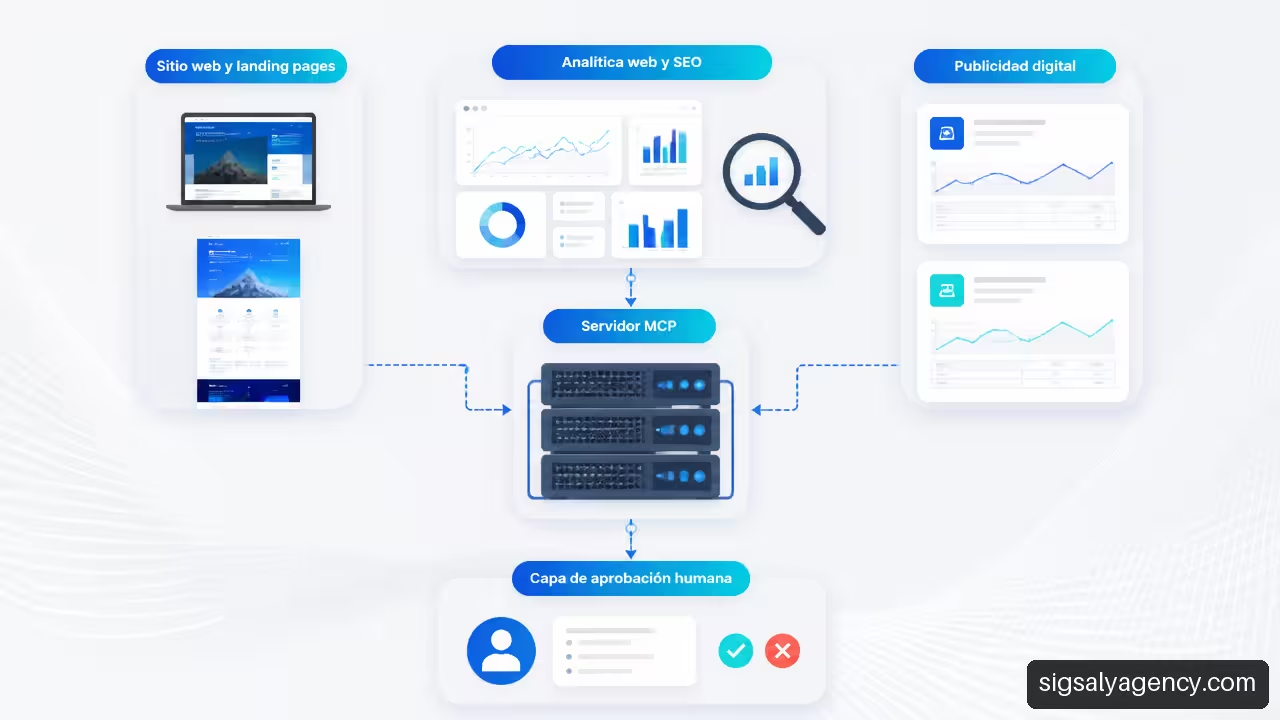
We can understand it with a simple image: the web is the shop, analytics is the counter of people entering, SEO explains how they arrived from search engines and advertising indicates how much it cost to attract them. MCP can act as the connector between those systems, but it does not replace design, strategy or human review.
A Website Prepared To Turn Data Into Decisions
A PPC campaign can drive traffic to a landing page, but the investment is wasted if the page does not match the search intent. An ad for «WordPress maintenance» should direct to a page that explains the service, provides proof, clarifies the next step and loads quickly. Directing that ad to a generic homepage makes it difficult to measure which message worked and reduces the conversion rate.
Web design orientated towards positioning must support four pieces that afterwards connected systems will be able to analyse meaningfully:
• Clear architecture: categories, services and content must have a hierarchy that is understandable for users and crawlers.
• Technical performance: load times, optimised resources and stable mobile experience affect navigation and can determine the outcome of a paid visit.
• Measurable conversion: forms, calls, purchases, downloads or budget requests need defined and verifiable events.
• Message coherence: ad, keyword, headline, content and call to action must respond to the same need.
That is why it is useful to consider the professional web design SEO and Google Ads by niche as a single discipline and not as isolated services. An attractive website without SEO structure can lose visibility. An apparently profitable campaign can hide low-quality conversions. And an automated report can seem accurate whilst comparing data that do not mean the same thing.
What MCP Brings Compared To An Isolated Consultation
The official API of a platform remains the basis that delivers data and executes, if permitted, certain actions. MCP adds a standardised communication layer so that a compatible assistant can access those functions without each conversation requiring an independent connection designed from scratch.
Google explains that its MCP server for Google Ads acts as a standardised bridge to the API to query and analyse campaign data using natural language. This can facilitate questions such as:
Microsoft Advertising documents a similar capability: its MCP server allows you to query campaigns, keywords and conversion changes from compatible assistants. The practical utility is not that the assistant replaces the specialist, but that it reduces the time spent gathering information before analysing it.
Automation is only useful when the question, metric and permission are well defined. A system that mixes clicks, sessions and conversions without clarifying their origin can give a quick answer, but a wrong one.
An Example Of Diagnosis With Meaning
Imagine a service page that receives many organic impressions, but few clicks. The system can review Search Console data if it has been connected, check in analytics whether that page retains visitors and contrast whether there is a Google Ads campaign using a similar proposal. It could then recommend reviewing the SEO title, meta description, main heading and page intent.
However, that recommendation does not prove that changing the title will increase sales. Perhaps the CTR is low because the query is informational, because there is very strong competition or because the result already partially answers the question. Here it is advisable to combine the automated signal with a business review: margin, commercial priority, seasonality and real capacity to meet demand.
Data Architecture for Web, SEO and Advertising
In order for web design – online marketing, integrated mcp systems to improve your positioning with connections to your website and your advertising campaigns to work, you must first resolve a less visible issue: which data is the main source for each decision. Without this rule, the assistant can compare incompatible figures and present a convincing conclusion, albeit an incorrect one.
Define A Primary Source For Each Metric
Not all platforms answer the same question. Google Ads reports on impressions, clicks, costs and conversions configured within its ecosystem. Google Analytics helps interpret sessions, behaviour and web events. SEO tools provide organic visibility, queries, crawling or indexing depending on the available source.
| Decision | Recommended Primary Source | Necessary Check |
|---|---|---|
| Adjust PPC budget | Advertising platform | Cost, conversions, attribution and margin |
| Improve a landing page | Web analytics and CRM if it exists | Events, valid forms and lead quality |
| Prioritise SEO content | Search data and organic performance | Intention, landing page and commercial potential |
| Fix technical issues | Web audit and crawl data | Indexing status, performance and internal links |
| Compare channels | Agreed attribution model | Period, time zone, currency and conversion definition |
An MCP layer can bring together several of these sources. Supermetrics describes that MCP can serve as a common layer to query data from different connected marketing platforms, such as analytics, CRM and advertising channels. But centralising does not equal normalising. That part must be designed.
Normalise Before Asking For Recommendations
Before allowing complex queries, document a simple data dictionary. It doesn't need to be huge, but it must define what each term means. If "conversion" is a purchase in Google Ads and a form submission in Analytics, comparing them as if they were the same result distorts the analysis.
It is advisable to agree, at a minimum:
- Campaign names and UTM: use consistent nomenclature to identify channel, service, audience, location and period.
- Conversion events: distinguishes between micro-conversions, such as a phone click, and business conversions, such as a confirmed sale.
- Comparison period: clarifies whether seven days, a full month or the same period from the previous year are being compared.
- Time zone and currency: a different daily closing can alter expense reports, sessions and revenue reports.
- Attribution model: define which system will be used to assess the contribution of each channel.
Fair warning: there is no universal architecture that automatically resolves these differences. A company with immediate online sales can prioritise net revenue per campaign. A service business with long sales cycles may need to connect forms with CRM and assess qualified opportunities, not just contact submissions.
Connect Your Web Without Losing Competitive Perspective
Beyond your own data, some companies need external context. Similarweb shows that their MCP server provides access to traffic metrics, acquisition sources and competitive intelligence. That type of information can help investigate channel trends, such as weight of organic search, direct access, referrals or paid search.
It should not be treated as exact truth about competitors. It is more useful as a guiding signal. For example, if a category shows a strong dependence on paid search, it may be reasonable to review whether the SEO strategy covers enough informational and commercial searches. The final decision should be based on your own data, objectives and content production viability.
The technical part of the web remains decisive. A campaign can attract visitors; a slow page, with form errors or no match with the advert can lose them. To strengthen that foundation, it is relevant to work on the Technical SEO: how to improve crawling, indexation and performance. MCP can point out patterns; it does not correct by itself a poor architecture or confusing user experience.
Automation With Control: Reading, Recommendation and Execution
The most important decision is not which assistant to use. It is what each connection can do. In advertising, a budget modification, campaign pause or ad publication has economic impact. That is why it is important to clearly separate access levels.
The Permission Matrix That Avoids Costly Errors
| Level | What The System Can Do | Risk | Recommended Control |
|---|---|---|---|
| Read-only | Consult metrics, campaigns, URLs and events | Low | Minimal access and query logging |
| Analysis | Detect anomalies, compare periods and propose actions | Medium | Data validation and human review |
| Preparation | Create drafts, reports or change lists | Medium | Approval before publishing |
| Writing | Adjust campaigns, budgets or ads | High | Double approval, limits and rollback plan |
Read-only mode is the reasonable starting point. It allows you to check whether the system understands the account structure, interprets metrics correctly and recognises missing data. Only when responses are consistently reviewed does it make sense to enable draft preparation. Direct writing should be exceptional, limited and supervised.
Design A Human Approval Flow
A secure flow does not have to be slow. It can be organised in five steps:
- Consultation: the system retrieves data from the web, analytics and advertising platforms with read permissions.
- Diagnosis: identifies a variation, for example, drop in conversions along with an increase in cost per acquisition.
- Explanation: displays the period, the metrics, the filters applied and possible causes, without asserting certainties that the data does not demonstrate.
- Draft change: proposes a concrete action, such as reducing a maximum budget or reviewing the associated landing page.
- Approval and registration: an authorised person validates, publishes and maintains traceability of the decision and subsequent result.
This last step matters more than it seems. If a campaign worsens after a change, it must be possible to answer what was modified, when, with what justification and how to revert it. Without a call log, responses and actions, automation becomes difficult to audit.
The Ad Context Protocol documentation reminds us that MCP advertising implementations must attend to call patterns, context and structured response processing. Translated into a daily operation: an ambiguous question must generate a clarification, not an automatic action.
How To Validate Responses Before Trusting Them
An assistant can summarise data fluently and still omit a filter, use an incorrect period or misinterpret a conversion. Validation must be operational, not intuitive.
• Contrasts a sample: compares figures from multiple responses with the original dashboards of each platform.
• Reviews freshness: confirms the date and time of update, especially in spend and revenue data.
• Requires context: asks you to specify period, account, campaign, currency, attribution and conversions included.
• Tests edge cases: checks paused campaigns, incomplete data, currency changes or pages without conversions.
• Measures usefulness: it is not enough for the answer to be correct; it must lead to a decision that can be justified and measured.
If reports reveal that the strategy no longer meets objectives, it is not advisable to maintain it out of inertia. Review online marketing: if the strategy isn't working for you, what are you waiting for to change it helps to position technology within a process of continuous improvement, not as a patch.
Key Ideas
What's Worth Remembering Before Integrating MCP
• MCP connects systems, but does not replace a well-designed website, solid technical SEO or a coherent campaign strategy.
• The main source of each metric should be defined. Clicks, sessions, conversions and revenue do not always mean the same thing across platforms.
• Start with read-only permissions. Analysing data is very different from modifying budgets or publishing advertisements.
• Normalise names, events, currencies, periods and attribution before automating reports.
• Require human approval for actions with economic impact. A revisable draft is usually safer than immediate execution.
• Validate the assistant's responses against the original systems. Reliable automation requires traceability, context and controls.
Frequently Asked Questions
What Is MCP And How Does It Apply To Web Design And Online Marketing?
MCP is a protocol for connecting AI applications with external data and tools. Applied to marketing, it can gather information from the web, analytics, SEO and advertising platforms to answer questions with more context. It does not improve positioning by itself; it helps detect priorities, errors and opportunities when data is properly configured.
What Is The Difference Between MCP And Using An API Directly?
An API allows programmatic access to a specific platform. MCP can offer a common interface for an assistant to query multiple connected tools. The API is still necessary in many cases, because it is the infrastructure that delivers data or enables actions. MCP is particularly useful when seeking a flow of queries and analysis across multiple sources.
Can MCP Detect Pages With Many Impressions And Low CTR?
Yes, if the system has access to organic performance data and the query is well defined. It can identify URLs with many impressions and few clicks, but the subsequent recommendation should be reviewed. A low CTR can be due to the title, search intent, position, competition or visual elements present on the search results page.
Can An Assistant Modify Advertising Campaigns?
It depends on the permissions granted and the functions exposed by the integration. It is advisable to separate query, analysis, draft preparation and execution. For spending changes, bids or ads, it is recommended to require human approval, investment limits and a log that allows reversing modifications.
How Do Google Ads, Microsoft Advertising And The Web Connect In The Same Flow?
First, the platforms are connected with controlled authorisations. Then campaigns are normalised, URLs with UTM parameters, conversion events and analysis periods. The assistant can consult the available data, but the report must indicate which source has been used for each metric and what attribution differences could exist.
What Security Risks Exist When Connecting Campaigns With AI?
The main risks are excessive permissions, exposed credentials, unapproved actions, access to sensitive data and lack of traceability. Reduce risk by applying minimum privilege, OAuth where possible, separation between test and production environments, access rotation, activity logs and limited write permissions.
When Is MCP Suitable And When Is A Custom Integration Better?
MCP can be appropriate when you need to query multiple sources through an assistant, generate reports, detect anomalies or create drafts of actions. A custom integration or ETL architecture may be preferable when very specific data models are required, large historical volumes, critical automations or complex business rules. In many cases, both options can coexist.
Sources and References
Verified Sources
• Google Developers — Google Ads MCP server: Developer integration guide: https://developers.google.com/google-ads/api/docs/developer-toolkit/mcp-server
• Microsoft Advertising — Microsoft Advertising MCP server: https://about.ads.microsoft.com/en/solutions/technology/mcp-server
• Similarweb Documentation — Similarweb MCP setup: https://docs.similarweb.com/api-v5/similarweb-mcp/mcp-setup
• Supermetrics — What is MCP in marketing?: https://supermetrics.com/blog/mcp-marketing
• Ad Context Protocol — MCP Guide: https://docs.adcontextprotocol.org/dist/docs/3.1.0-rc.10/building/by-layer/L0/mcp-guide