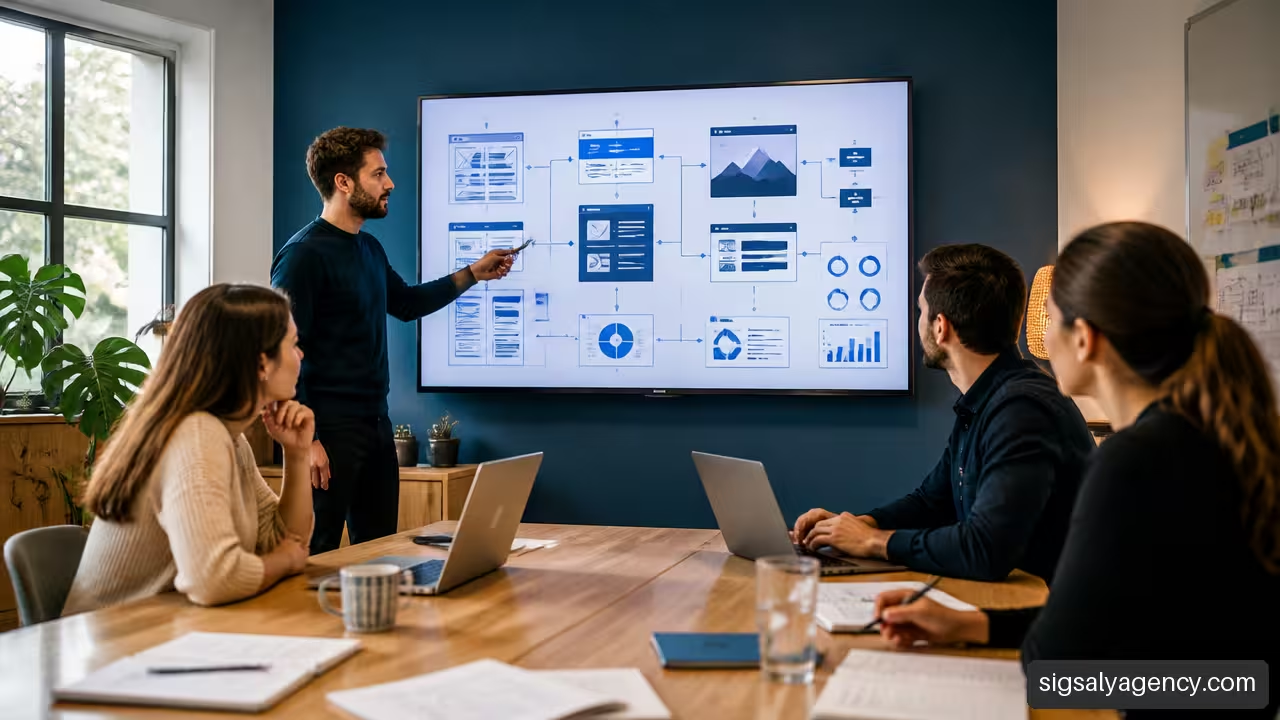
He custom WordPress business website development consists of building a digital platform aligned with an organisation's processes, objectives and teams. It is not simply about applying a template with corporate colours: it involves defining what the website should do, what systems it should connect to, who will be able to publish and how its results will be measured.
WordPress can be a solid foundation for a corporate website, a shop, a client portal or a booking system. However, the final quality depends less on the CMS and more on prior decisions: scope, architecture, performance, security, permissions and maintenance. An attractive website that loses forms, loads slowly or doesn't sync contacts with the CRM ceases to be a reliable business tool.
Table of Contents
- What A Bespoke Project Should Include
- Architecture, Integrations And Technical Ownership
- Design, SEO And Editorial Management
- Launch, Migration And Continuous Improvement
- Key Points For Decision Making
- Frequently Asked Questions
What A Bespoke Project Should Include
A bespoke corporate website starts by translating business objectives into verifiable features. If the goal is to increase business enquiries, a contact section alone is not enough. You need to specify what data the form collects, which team receives it, how long the response takes and how it is recorded in the CRM.
My recommendation is to define the scope before designing screens. This way, the design responds to a real function and does not force you to rebuild components when technical requirements emerge later.
From Idea To A Scope Matrix
A scope matrix converts vague phrases, such as 'we want to attract more customers', into actionable decisions. For each need it is advisable to indicate the person responsible, priority, dependency and acceptance criteria.
| Business Need | WordPress Solution | Acceptance Criteria | Usual Responsible |
|---|---|---|---|
| Capture enquiries | Form connected to the CRM | The contact arrives without duplicates and receives confirmation | Marketing and sales |
| Publish success stories | Custom content type | The team can create, filter and update cases without touching code | MARKETING |
| Sell products | WooCommerce and business rules | The order reflects correct taxes, stock and shipping method | Ecommerce and administration |
| Manage bookings | Booking engine or external integration | Already occupied time slots are not confirmed | Operations |
| Work in multiple markets | Multilingual or multi-domain architecture | Each language retains its URLs, content and metadata | Marketing and SEO |
The acceptance criteria avoid a common problem: a feature seems finished because
What Is Customisation And What Is Real Development
Customising WordPress can mean adjusting a template, installing plugins and configuring blocks. It is valid when the business has simple needs, a small budget and a stable content catalogue.
Custom development goes further. It can include a custom theme, specific Gutenberg blocks, content types, business rules, integrations and a component system with consistent colours, spacing and typography. Custom development as described by Artproject Group can include custom plugins, integrations with management systems and business processes that a standard theme does not cover.
The difference is not aesthetic. A template can solve an informational service website; a portal with rates per client, connection to an ERP and order statuses requires a more controlled technical layer.
When To Choose Template, Custom Theme Or Application
Not all companies need the same level of development. Choosing an overly complex solution when unnecessary increases maintenance; choosing the simplest one when the process is critical can block growth.
| Option | Suitable When | May Not Be Appropriate When |
|---|---|---|
| Well-configured template | The website is primarily informational and changes are moderate | The brand, workflows or integrations require singular rules |
| Custom WordPress theme | There are specific editorial, commercial and brand needs | Business logic is very complex and changes continuously |
| Independent application connected to WordPress | WordPress should manage content, but another platform processes complex operations | The project only needs content, forms and simple automations |
WordPress does not have to contain all business logic. If an organisation needs complex calculations, multiple transactional permission rules or intensive processing, it may be more prudent to place that logic in an independent application or service. WordPress can continue to act as a CMS and consume data through a REST API.
To delve deeper into structure, technology and experience decisions, it is useful to review the approach of web development and design with WordPress.
Architecture, Integrations And Technical Ownership
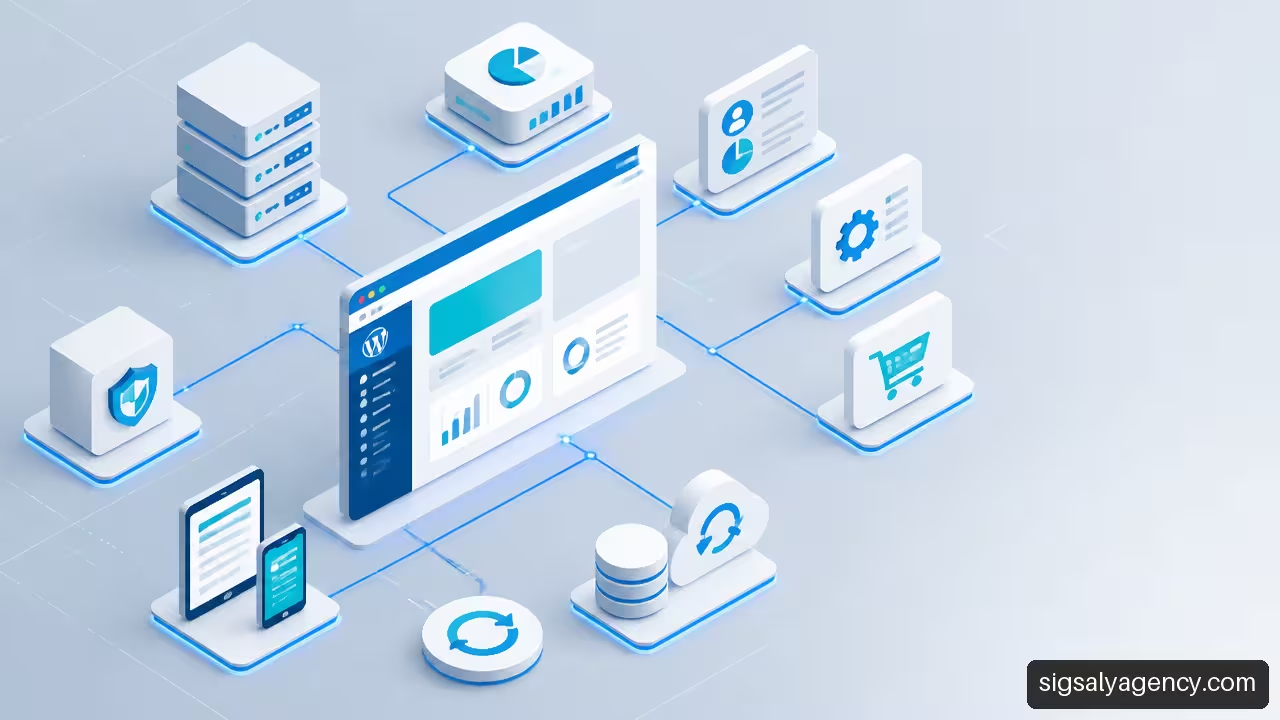
A business website usually exchanges information with CRM, ERP, email marketing platforms, payment gateways, booking systems or internal tools. Integration does not end when connecting two fields. It must anticipate what happens when the external service responds late, changes its format or becomes unavailable.
Integrations That Don't Lose Data Silently
A reliable integration needs traceability. If a visitor submits a request and the CRM fails, the system should not just display a generic message. It must log the event, securely preserve the data when appropriate and apply a retry strategy or alert the responsible team.
WPPoland's custom development description contemplates fault-tolerant integrations, retries, technical testing, accessibility validation and controlled launches. It is a good reference scope for requiring that an integration does not depend solely on whether "it works today".
A reasonable technical design can include:
• Input validation, to prevent incomplete data, incorrect formats or malicious submissions.
• Unique identifiers, to reduce the risk of duplicating contacts or orders during a retry.
• Technical logs, indicating when a request failed, which system was involved and what action was taken.
• Queues or scheduled tasks, useful for non-urgent synchronisations, such as stock, catalogues or customer data.
• Operational alerts, so that a persistent error reaches a person and is not discovered weeks later.
Let us consider a catalogue connected to the ERP. If the ERP does not respond, it may be preferable to display the last synchronised data with an update mark, rather than delete the entire catalogue. The appropriate option depends on the risk: for regulated prices or critical availability, it may be better to temporarily prevent purchase than to sell with incorrect information.
Separate Own Code And External Dependencies
Plugins save time, but not all should become central pieces of the operation. A form plugin can be appropriate; an extension that controls all pricing, customer and billing logic can create a difficult-to-replace dependency.
It is worth documenting what belongs to the company and what belongs to third parties:
| Element | Control Question | Recommended Measure |
|---|---|---|
| Custom theme | Where is the repository and who can update it? | Code delivery, documentation and version control |
| Third-party plugin | Does it have valid licensing and active maintenance? | License inventory, version and possible alternative |
| API integration | What happens if the provider changes? | Data contract, records and separate integration layer |
| Hosting | Who owns access, domain and backups? | Clear ownership and recovery procedure |
Technical ownership is not an isolated contractual detail. It affects business continuity. A company should be able to identify its access, licences, dependencies and backups without relying on a single person or supplier.
Architectures To Grow Without Redoing Everything
WordPress allows you to create custom content types for services, delegations, projects, resources or events. Taxonomies help classify them, whilst custom fields provide structured data. This reduces repetition and improves filters, navigation and SEO.
PIT Solutions proposes WordPress as the foundation for corporate websites, multi-domain architectures, custom themes, own plugins and API integrations. These possibilities are useful when several brands share technology, but require different content and domains.
Even so, it is not advisable to implement a multi-domain architecture just for foresight. If the company operates with a single brand and language, a simple structure will be easier to maintain. Useful scalability responds to a likely and defined need, not to accumulating technical layers "just in case".
Design, SEO And Editorial Management
Custom business design should reduce friction: explain what the company offers, guide the user and facilitate concrete action. Visual identity matters, but so does content hierarchy, forms, error messages, contrast and loading speed.
A Design System That The Team Can Use
Good development does not deliver only closed pages. It delivers reusable components: headers, calls to action, cards, tables, testimonials, question blocks and contact modules. In Gutenberg, these patterns allow marketing to create new pages without altering visual coherence.
The design tokens help maintain order. They are reusable values for colours, typography, sizes and spacing. If a corporate colour changes, it shouldn't be necessary to modify dozens of blocks manually.
Accessibility must come in from the design stage, not at the end as a correction. Understandable buttons, correct heading order, visible focus when navigating with the keyboard and useful alternative texts are basic decisions. A website that only works with a mouse or relies on colour to explain a state excludes part of its audience.
The strategic guide for professional web design expands on how to relate accessibility, performance and design decisions from the start of the project.
Technical SEO Integrated Into The Architecture
WordPress makes it easy to manage titles, meta descriptions, URLs, images and content. But SEO doesn't appear just by installing a plugin. It requires a structure that search engines and people understand.
Before publishing it's worth defining:
• The URL structure and priority pages by search intent.
• Metadata templates for services, categories, products or locations, where relevant.
• Logical internal linking, avoiding isolated pages and bloated menus.
• Structured data only when it reflects real information on the page.
• Redirects to preserve valuable URLs after a migration.
Agile Digital Agency describes a scope of enterprise WordPress that can include UX/UI, programming, APIs, performance, migrations and bespoke corporate websites. That combination makes sense: technical SEO depends on the architecture, but also on the experience that allows turning a visit into an inquiry.
Performance Budgets Before Programming
Saying a website should be fast isn't enough. A performance budget sets technical limits before development: page weight, number of resources, image size, script usage, queries or expected response time on key pages.
For example, a service page with background video, carousels and five tracking tools may look visually ambitious, but load too many resources. The useful question is not whether each element
Performance decisions usually include image optimisation, caching, lazy loading where appropriate, removing unnecessary code and choosing hosting. A well-configured server does not fix a heavy page by itself; likewise, a lightweight design does not compensate for unstable infrastructure.
The link between lead generation, content and visibility is better understood when integrating web design and online marketing into a single strategy, rather than treating the website as a separate piece from campaigns and SEO.
Launch, Migration And Continuous Improvement
Publishing a website should not be a leap of faith. It is an operational change that can affect organic traffic, forms, payments, emails, access and internal processes.
Migrating Without Losing What Already Works
An orderly migration begins with inventory. You need to collect URLs, content, images, forms, conversions, analytics tags, users, downloadable files and existing integrations. It is also advisable to identify pages that receive traffic or relevant external links.
The plan should include these steps:
- Create a testing environment separate from production.
- Map old URL, new URL and required redirect.
- Validate forms, emails, payments, search and permissions.
- Prepare verified copies of files, database and configuration.
- Define a rollback plan with clear responsibilities and conditions.
- Publish, review DNS and SSL, warm up caches and monitor errors.
Webservi notes that a bespoke WordPress website can be oriented towards lead generation, services, sales or bookings and tested before publishing. In business projects, that test must cover the complete journey, not just the visual aspect across different devices.
He rollback plan deserves special attention. If a critical issue appears after launch, there must be a documented way to return to the stable version. This may involve restoring a backup, temporarily redirecting traffic or disabling a specific integration. The important thing is that the decision is not made up under pressure.
Measuring The Result After Publishing
Publishing opens a phase of improvement. Measuring visits is useful, but insufficient. A business website should review indicators associated with its main objective.
| Objective | Useful Indicators | Review Signal |
|---|---|---|
| Acquisition | Valid requests, submission rate, contact source | Many incomplete submissions or contacts that do not reach sales |
| Ecommerce | Orders, abandonment, payment errors, average value | Checkout drops or differences with the ERP |
| Editorial Management | Publication time, incidents, block reuse | The team depends on support for simple changes |
| Performance | Load metrics, server errors, page weight | Deterioration after adding campaigns or plugins |
| SEO | Indexation, redirects, traffic from key pages | Loss of URLs, 404 errors or drop in visibility |
There is no universal figure that guarantees success. A B2B services website can receive few contacts, but highly qualified ones; a shop can prioritise transactions and reduce payment errors. That is why analytics must be connected to the actual commercial process.
Maintenance, Security And Knowledge Transfer
Maintenance does not consist solely of updating WordPress. It includes reviewing compatibilities, backups, security, performance, integration errors and editorial health. An automatic update without testing can break a critical form; never updating increases technical risk.
Upon project completion, the company should receive practical documentation:
• Inventory of domains, hosting, users, licences and external services.
• Instructions for publishing, reviewing and retrieving content.
• Integration map, securely managed credentials and responsible parties.
• Backup, restoration and rollback procedures.
• Log of technical decisions and known dependencies.
A corporate website is not truly delivered when it is published. It is when the team can operate it, measure it and recover it with control.
Key Points For Decision Making
• Define business objectives and acceptance criteria before approving designs or plugins.
• Choose a template when the need is standard; opt for custom development if processes, content or integrations require specific control.
• Design integrations to fail visibly and recoverably, not to depend on a perfect connection.
• Separate your own code from third-party dependencies and document licences, access and alternatives.
• Establish performance budgets and accessibility rules from the start, not as final adjustments.
• Treat migration as a technical project with redirects, testing and rollback plan.
• Measure the website according to business results: valid contacts, sales, bookings, editorial efficiency or service quality.
Frequently Asked Questions
What Does The Development Of A Custom WordPress Business Website Include?
It may include content strategy, architecture, UX/UI design, custom theme, Gutenberg blocks, content types, forms, technical SEO, analytics, integrations, testing, migration, training and maintenance. The specific scope should depend on the processes the website needs to resolve.
When Is A Template Suitable And When Is A Custom Theme Needed?
A template is usually sufficient for a simple website, with stable structure and common requirements. A custom theme is more reasonable when the brand needs exclusive components, there are multiple content types, the editorial team requires specific workflows or the website integrates with business systems.
How Much Does A Custom WordPress Business Website Cost?
There is no reliable universal tariff. The budget changes according to the number of templates, visual complexity, migration, integrations, ecommerce, languages, permissions, performance and maintenance. Request a breakdown of deliverables and acceptance criteria; comparing only an initial figure can hide subsequent costs.
Can WordPress Be Integrated With A CRM Or ERP?
Yes, through APIs, connectors or specific development. Before approving the integration, it is advisable to define fields, synchronisation frequency, rules for duplicates, permissions, error logs and what happens when one of the systems is unavailable.
How Are Permissions Organised For Marketing, Sales And Administration?
WordPress allows you to assign roles and capabilities. Marketing can create drafts, designated managers can approve publications and administration can manage sensitive settings. Editorial governance should indicate who publishes, who reviews and how changes are corrected, especially in legal, commercial or regulated content.
How Do You Migrate An Old Website Without Losing Traffic Or Forms?
An inventory of URLs is needed, 301 redirects, content export or reconstruction, testing of forms and integrations, review of analytics tags and subsequent monitoring. It is also prudent to maintain a verifiable copy of the previous version and a rollback plan.
What Maintenance Does An Enterprise WordPress Website Need?
It needs controlled updates, backups, security review, error monitoring, checking of forms and integrations, performance optimisation and editorial support. The frequency depends on the activity and criticality of the site, but leaving it without review for long periods increases risk.
Sources and References
Consulted Sources
• Artproject Group + Custom web development with WordPress and WooCommerce: https://artprojectgroup.es/servicios/desarrollo-web
• Agile Digital Agency + High-Performance WordPress Development Agency: https://www.agiledigitalagency.com/es/servicios/desarrollo-wordpress/
• WPPoland + Custom WordPress Development in Alicante: https://wppoland.com/es/desarrollo-personalizado-alicante/
• PIT Solutions + Create powerful websites with WordPress: https://www.pitsolutions.com/es/tecnologia/wordpress
• Webservi + Custom WordPress web design for businesses: https://www.webservi.es/diseno-web/webs-wordpress/