A specialist WordPress agency for small businesses It can transform a basic website into a clearer, more secure, and easier-to-manage business tool. My recommendation is not to focus solely on the initial design: a good decision should consider asset ownership, maintenance, technical SEO, support, and scalability.
Table of Contents
- What Should a WordPress Agency Solve?
- How to Evaluate the Service Before Hiring
- Real Cost of a WordPress Website for 12 Months
- Key Takeaways
- Frequently Asked Questions
- Sources and References
What Should a WordPress Agency Solve?
An agency shouldn't just install a template, add a form, and publish the page. For a small business, WordPress should help explain services, capture leads, manage content, sell products, or facilitate bookings without creating unnecessary technical dependencies.
WordPress is a flexible CMS, but that flexibility comes with a catch: every plugin, theme, payment integration, or form adds a piece that must be maintained. Therefore, my approach is simple: the more crucial the website is for invoicing, acquiring customers, or fulfilling orders, the more important it is to have a provider who understands both the technical and commercial aspects.
A Website That Responds to a Business Objective
Before discussing colors, animations, or plugins, the agency should define the website's purpose. A clinic might need appointment booking. A professional firm might prioritize qualified forms and expertise in the subject matter. A WooCommerce store should especially protect the checkout process, payment gateways, product catalog, and order confirmation emails.
The useful question is not "Do I want a beautiful website?", but this: What action should a person complete after visiting each page?
A well-formulated response usually translates into concrete decisions:
• A homepage with a value proposition, priority services, and visible contact methods.
• Service pages designed to answer questions before the sales call.
• Short forms that only request the necessary data.
• Responsive design so the experience works on mobile, tablet and computer.
• Measurement of relevant events, such as phone clicks, form submissions, bookings, or purchases.
• Editable content so that the company does not depend on a developer for every small change.
To delve deeper into the structure, performance, and customization of a website based on this CMS, it may be helpful to review the approach of web development and design with WordPress.
Development, Maintenance, and Evolution Are Not the Same Thing
It's common for a job posting to combine several tasks under a single label like "web support." However, it's best to separate them into three layers.
| Service Layer | What's Included | When Is It Necessary |
|---|---|---|
| Initial development | Architecture, design, configuration, content, forms and integrations | When launching, redesigning, or migrating a website |
| Technical maintenance | Updates, backups, security, monitoring, and bug fixing | Throughout the entire lifespan of the website |
| Commercial evolution | SEO, conversion improvement, content, campaigns, and data analysis | When a company wants to grow, it's not enough to just keep the website active. |
Confusing these layers leads to frustration. For example, updating WordPress doesn't automatically improve your organic ranking. Ensuring your site loads correctly doesn't guarantee that your service pages will convert. And having a backup doesn't guarantee a quick restoration if it's never been tested.
Some agencies present website creation, WooCommerce, technical SEO, migrations, and compromised site recovery as separate services. The proposal of Ants in the Cloud for WordPress This illustrates the separation between website creation, maintenance, migration, recovery from hacked websites, e-commerce, and technical SEO. For an SME, this distinction is valuable: it allows them to know what is included and what will require an additional budget.
When is a real specialization in WordPress needed?
Not all websites require custom development. A simple corporate website, with minimal content and no critical processes, can be managed with a basic configuration and minimal maintenance. In that case, paying for a complex solution might be unnecessary.
Specialization becomes more important when there are specific risks or dependencies:
• A WooCommerce store with payments, stock, orders, or coupons.
• A booking system connected to external calendars or services.
• Forms that collect personal data or sensitive requests.
• Integrations with CRM, billing, email automation, or private areas.
• Recurring problems such as slowness, crashes, malware, or incompatibilities.
• A project that needs functionalities not covered by a standard plugin.
In such cases, an agency must be able to explain what depends on WordPress, what depends on the hosting, which plugin is involved, and what part of the process requires custom development. WP Agency describes enterprise WordPress developments with integrations and custom development, as well as WooCommerce websites and stores.This doesn't mean that every SME needs that complexity, but it does mean that it should identify it before it becomes a problem.
How to Evaluate the Service Before Hiring
My recommendation is to request a verifiable proposal. Phrases like "fast website," "maximum security," or "full support" may sound good, but they don't indicate frequency, scope, or responsibility. A useful proposal specifies deliverables, limitations, and the work process.
The Initial Audit Must Identify Real Risks
If the company already has a website, the first step should be an audit. It doesn't need to be an endless document, but it should review what could affect revenue, visibility, or operational continuity.
A reasonable audit may include:
- WordPress status, theme and active plugins.
- Compatibility with PHP version and server.
- Performance of key pages, especially home, contact, product pages and checkout.
- Forms, transactional emails, links, redirects, and SSL certificates.
- Backup configuration, frequency, retention, and restore capabilities.
- Basic security, administrator users, permissions, malware scanning, and protection measures.
- Indexing, technical SEO errors, sitemaps, and analytics.
- Ownership and access to domain, hosting, Search Console, Analytics, email accounts and premium licenses.
An audit shouldn't promise Google rankings or future sales. It can, however, reveal flaws that prevent a business from competing effectively. For example, if a form sends emails to a non-existent account, the problem isn't just cosmetic: every potential lead is lost without the business even knowing.
Safe Updates: Staging, Testing, and Rollback
Updating plugins directly on a live website can break a template, form, payment method, or integration. The risk increases on sites with WooCommerce, multiple languages, visual builders, or many interconnected extensions.
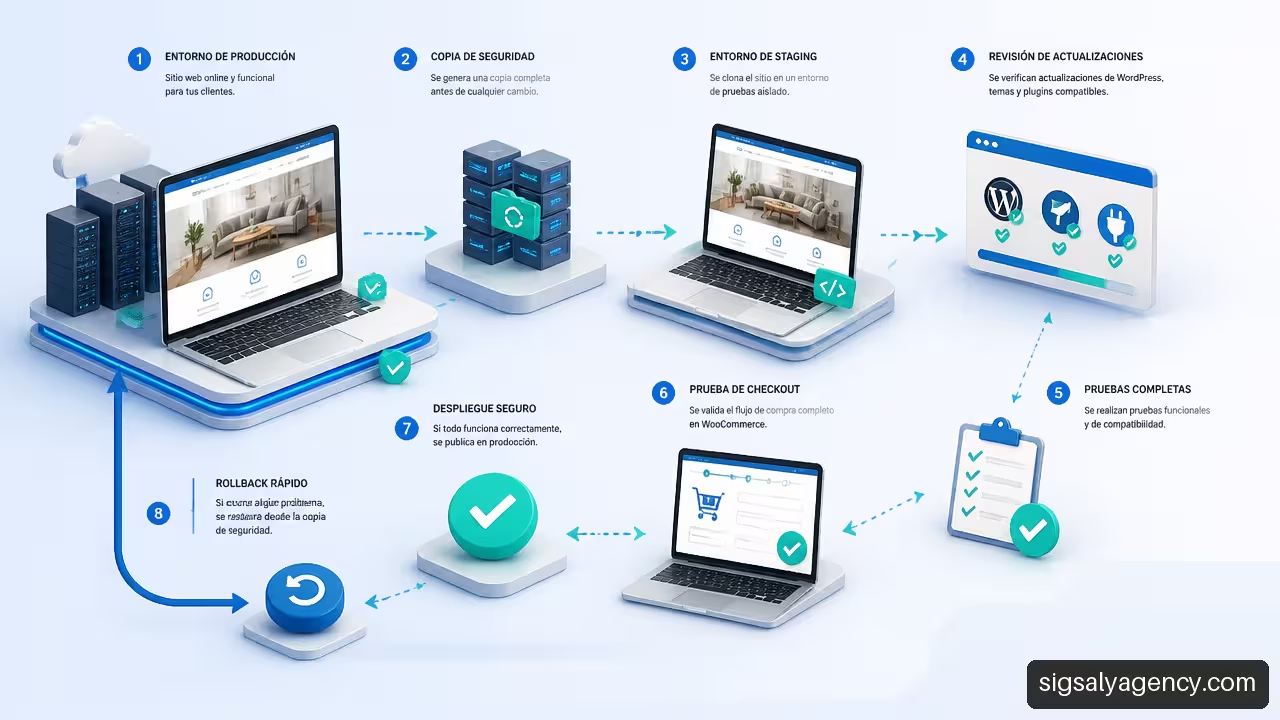
Therefore, an agency should describe its protocol. staging It's a test copy where changes are applied before being deployed to production. rollback It allows you to revert to a previous version if a bug is detected. These aren't absolute guarantees, but they reduce the impact of foreseeable errors.
A responsible update isn't just about pushing a button. It's about identifying potential problems, validating critical functions, and having a recovery plan in place if something stops working.
A practical process can follow these steps:
- Create or verify a recent backup of files and database.
- Apply updates to staging sites when the site has critical processes.
- Review navigation, forms, search engine, booking, payment, and relevant emails.
- Schedule the transition to production during a period of lower impact whenever possible.
- Monitor the website after the change and use rollback if a serious issue arises.
Not all small businesses need a separate testing environment for every text tweak. But a store that receives orders daily should definitely consider this approach. The practical difference is clear: changing an image doesn't carry the same risk as updating a payment plugin.
Support, SLAs, and limits that must be in writing
The SLA is the agreement that defines the level of service. For a small or medium-sized business without a technical team, it helps to know what happens when an issue arises and who is responsible.
There's no single right timeframe for every business. An informational website can tolerate responding to inquiries during business hours. A store with a failed checkout requires a different approach. The key is that the contract clearly defines the situation.
| Aspect to Compare | Question to Ask | Clarity Sign |
|---|---|---|
| Schedule | Does support only operate on weekdays? | Defined schedules and specified contact channel |
| First response | How long does it take the agency to confirm an incident? | Estimated time by priority |
| Resolution | Is there a difference between an answer and a solution? | Explanation of dependencies and realistic deadlines |
| Changes included | How many hours or tasks does the plan cover? | Specific monthly limits |
| Emergencies | What is considered a critical incident? | Examples include crashes, failed payments, or malware |
| Exclusions | What is billed separately? | List of out-of-scope jobs |
Web Specialists differentiates its maintenance services according to website type, volume, online store, advanced security, and support hours.This way of segmenting plans is more useful than simply comparing a monthly fee, because the same price can cover very different needs.
Asset Ownership and Exit Plan
A company should retain operational control of its digital assets, even when delegating management. This includes domain, hosting, WordPress admin accounts, backups, Analytics, Search Console, email, paid profiles, and licenses.
My view is that the agency should have technical access, but the SME needs to know where the accounts are, how to recover them, and who is listed as the account holder. Otherwise, switching providers can become an awkward negotiation.
Before signing, it's advisable to agree on what will be given if the relationship ends:
• Full backup of files and database.
• List of plugins, theme, licenses and renewal dates.
• Credentials or secure transfer procedure.
• Documentation of integrations, redirects, and special configurations.
• Access to statistics, advertising accounts, and measurement tools.
• Status of pending tasks and possible known incidents.
It's not a matter of mistrust. It's a basic measure of continuity. If an agency operates properly, an orderly exit plan also protects both parties.
Real Cost of a WordPress Website for 12 Months
The initial price rarely tells the whole story. To compare offers, I recommend calculating the total cost of ownership for twelve months: construction, hosting, maintenance, licenses, support, changes, taxes, migration and possible out-of-scope work.
Why Monthly Fees Are Not Comparable on Their Own
The offers published on the market can range from very low prices to plans costing over €195 per month, but this difference makes it impossible to decide without reviewing the scope. A budget plan might only include updates. Another might include hosting, a domain, SSL, daily backups, scanning, and monthly updates.
Cardeseo offers maintenance plans that can include hosting, domain, SSL, daily backups, scanning, and monthly updatesThe lesson is not that one model is better than another, but that each company should review whether these concepts are included, whether they have limits, and who is responsible for renewal.
| Line item | May be included | It can be billed separately. |
|---|---|---|
| Design and development | In closed projects | Unforeseen changes or new sections |
| Hosting and SSL | In some maintenance | Server, mail or resource expansion |
| Premium licenses | Sometimes during the contract | Annual renewal or license ownership |
| Maintenance | Basic updates and backups | Malware removal, emergencies, or development |
| technical seo | Initial Reviews | Content, strategy and links |
| Support | Monthly time bank | Additional hours or urgent care |
A five-page corporate website shouldn't be budgeted like a store with hundreds of products. Similarly, a store with a small catalog may require more monitoring than an informational website, because errors in payment, stock, or orders directly impact sales.
Published Prices, Length of Stay and Conditions
The prices shown can serve as a starting point, not as a definitive reference. Agarimo Comunicación highlights differences between plans, services for stores, and a minimum contract of six months.This length of stay is an example of a condition that should be read along with the price, the hours included, and the services excluded.
The right proposal depends on the company's current situation:
• New and simple website: It is advisable to prioritize a clear architecture, a responsive design, well-defined core content, and an easy-to-maintain configuration.
• Existing website with errors: It is advisable to start with auditing, recoverable backups, security, cleaning up unnecessary plugins, and correcting critical errors.
• WooCommerce Store: It is advisable to add proof of purchase, email review, monitoring, update control, and an incident protocol.
• A project that seeks to grow: It is advisable to separate technical maintenance from SEO, content, advertising and conversion optimization work.
For a company looking to connect its website with demand generation, it can be helpful to understand how they relate professional web design SEO and Google Ads by nicheDesign attracts attention, but a business strategy also needs consistent messaging, measurement, and acquisition channels.
How to Measure If the Investment Is Working
It's unwise to promise a fixed percentage improvement in traffic, sales, or speed. The outcome depends on the sector, competition, offerings, investment, starting point, and the quality of the company's sales service.
Even so, an agency should agree on key performance indicators (KPIs) before starting work. It's not necessary to measure everything. It's enough to choose metrics that are relevant to the actual objective.
| Objective | Useful Metric | Caution |
|---|---|---|
| Gather contacts | Forms sent, calls or requests | Check if the contacts are qualified |
| Sell online | Orders, revenue, checkout abandonment rate | Separate technical problems from insufficient demand |
| Improve visibility | Impressions, clicks, and indexed pages | Technical SEO alone does not guarantee rankings |
| Reduce incidents | Detected crashes, critical errors, and restorations | Monitoring uptime does not validate forms or payments |
| Improve performance | Load metrics on priority pages | Measure under comparable conditions |
A website doesn't function in isolation. The sales proposition, reviews, customer service, and marketing campaigns all influence the results. That's why integration is key. Web design, online marketing, and MCP to improve your ranking It can help to understand the relationship between web experience, content, and visibility, without assuming that a single action will solve all digital growth.
Key Takeaways
Decisions That Protect Investment
• Choose an agency based on verifiable deliverables, not just a promise of attractive design or full maintenance.
• Separate initial development, technical maintenance, and commercial evolution to avoid confusing expectations.
• Require an update protocol with backups, testing, staging when necessary, and the possibility of rollback.
• Compare prices with the total annual cost of ownership, including licenses, hosting, VAT, support, and out-of-scope changes.
• Maintain company control over the domain, hosting, administrator accounts, analytics, backups, and documentation.
• Define support priorities according to the actual risk: a corporate website and a WooCommerce store do not need the same SLA.
The Final Question Before Signing
The best agency isn't necessarily the one that offers the most tools or the lowest fee. It's the one that can explain, in clear language, what it will and won't do, how it will respond to a failure, and what the company will retain if it decides to switch providers.
Frequently Asked Questions
What Exactly Does a WordPress Agency Do for a Small Business?
You can design, develop, migrate, maintain, and optimize a WordPress website. Depending on the project, you can also handle technical SEO, WooCommerce, integrations, security, backups, performance, and support. The key is to define the scope: a new website, monthly maintenance, and a lead generation strategy are related but distinct services.
How much does it cost to create a WordPress website for an SME in Spain?
There's no single, reliable price. The cost depends on the number of pages, content, customization, online store, bookings, languages, migration, integrations, and SEO work. To compare quotes, it's advisable to request a breakdown of deliverables, timeline, revisions, licenses, and excluded tasks. A lower quote might end up being more expensive if it requires redoing essential features later.
What Should a WordPress Maintenance Plan Include?
At a minimum, you should define updates, backups, security, bug fixes, and support. You should also clarify task frequency, backup retention, restore method, included hours, incident handling, and exclusions. If WooCommerce is used, it's reasonable to include purchase verification and transactional emails.
Is it better to hire a WordPress agency or a freelance professional?
It depends on the complexity and the level of support required. A freelancer can be a good fit for small, straightforward projects if they offer clarity, availability, and the necessary expertise. An agency can provide broader coverage when design, development, SEO, advertising, analytics, and maintenance are involved. The key factor isn't the label, but the ability to deliver on the agreed-upon scope.
How do I know if an agency has real experience with WooCommerce?
It's worth asking about their technical process, not just their visual portfolio. They should be able to explain how they review payments, orders, stock, emails, updates, performance, and recovery from failures. They should also be able to distinguish between simple catalog changes and developments that affect the checkout, payment gateway, or external integrations.
What Happens If My WordPress Website Has Been Hacked?
Malware removal typically requires specific work. This may involve isolating the site, analyzing files, removing malicious code, restoring a secure backup, changing credentials, updating components, and investigating the source of the access. It shouldn't be assumed that this will be included in any maintenance fee; it's best to confirm it in writing beforehand.
Who Should Own the Domain, Hosting, and Administrator Accounts?
The company should retain control of these assets, even if the agency manages their technical configuration. This facilitates renewals, audits, vendor changes, and incident recovery. Access should be managed securely, but ownership should not be locked in an account outside the business.
Do I Need Maintenance If My Website Hardly Changes?
Yes, basic maintenance is usually recommended. Even if the content doesn't change, WordPress, plugins, themes, the server, and security measures may require review. The level of maintenance depends on the risk: a simple informational website may need less intervention than an online store, but leaving it unattended for extended periods increases the likelihood of discovering problems too late.
Sources and References
Verified Sources
- Agarimo Comunicación — WordPress Maintenance for Businesses: https://www.agarimocomunicacion.com/mantenimiento-wordpress/
- Ants in the Cloud — WordPress Agency: https://hormigasenlanube.com/
- Web Specialists — WordPress Website Maintenance: https://especialistasweb.es/mantenimiento-web/
- Cardeseo — Professional WordPress Maintenance: https://cardeseo.com/mantenimiento-wordpress
- wpagency.es: https://wpagency.es/