Creating a professional digital presence for a small business isn't about opening profiles on every social network or launching a website as quickly as possible. It's about building a simple system that explains what the business does, builds trust, and facilitates a specific action: calling, requesting a quote, booking an appointment, or making a purchase.
A useful online presence must be sustainable with the company's actual resources. My recommendation is to start with the assets the SME controls, connect each channel to a business objective, and measure business actions, not just visits or followers.
Table of Contents
- Define the Priority Before Designing
- Choosing the Right Digital Architecture
- Launch, Measure, and Maintain Your Online Presence
- Key Ideas
- Frequently Asked Questions
Define the Priority Before Designing
The first decision is neither aesthetic nor technological. It's commercial: What should the digital presence achieve in the coming months? An answer like "to have more visibility" is too broad to determine pages, content, or investment. It should be made more concrete and observable.
For example, a professional firm might prioritize meeting requests. A local business might want calls, store visits, or orders. An industrial company might need qualified contacts for complex quotes. Each objective requires a different architecture and measurement.
The Chamber of Commerce points out that a digital roadmap should be based on the company's maturity, objectives, and priority needs. It also presents the website as an extension of the business and as a foundation for SEO and content creation. The Spain Digital Business Guide of the Chamber of Commerce This incorporates a prioritized planning approach.
Turning Goals into Measurable Actions
I propose starting with a simple decision table. It forces you to link each investment to a specific action and avoids scattering the budget on tools that don't address a clear need.
| Business Objective | Main User Action | Priority Asset | Useful Metric |
|---|---|---|---|
| Obtain quotes | Fill out a form or call | Corporate website with service pages | Applications received |
| Validate a specific offer | Leave your details or book a call | Landing page | Conversions per campaign |
| Sell standardized products | Add to cart and checkout | Online store | Orders and income |
| Attract local customers | Call, request directions, or visit | Business profile and local website | Calls, clicks and visits |
| Retain existing customers | Check for news or support | Content and email area | Repetition of contacts |
A metric should reflect business value. A visit can signal interest, but it doesn't prove that the channel offers opportunities. In contrast, a recorded call, a confirmed booking, or a valid form does allow you to start a conversation about quality and profitability.
Understanding the Value Proposition and the Audience
Before writing a single page, the SME should be able to clearly answer four questions:
• What specific problem does it solve?
• Who does it solve for?
• What alternative does that customer usually use before choosing the company?
• What test reduces your doubt before contacting?
The last question is often overlooked. However, it's crucial. Someone looking for an electrician, a consultant, or a renovation company needs to quickly know their coverage area, specialization, process, contact methods, and basic terms and conditions. If this information is buried under generic messages, the website might be attractive but still fail to convert leads.
A professional digital presence doesn't try to say everything. It organizes the information so the right customer can quickly understand if the company can help them.
Prioritize When Time and Budget Are Limited
There's no universal sequence. A local service SME and a brand with national sales don't start from the same place. Even so, I usually recommend prioritizing based on dependency: first, your own assets; then, visibility; and finally, acceleration through campaigns.
- Secure domain, corporate email, contact information and a functional website.
- Create pages that answer real business searches and questions.
- Work on your business profile, basic SEO, and a social media channel that your audience actually uses.
- Add content, digital advertising, or automations once conversion can be measured.
Opening five social media accounts before having a clear strategy often results in outdated profiles, slow responses, and inconsistent messaging. It's better to maintain a consistent presence on one channel than to try to appear to be on all of them.
The selection of channels should be related to the value proposition and the target customers. This idea appears in the Guide to creating a digitization plan for Acelera PymeIn practical terms, a network is suitable when it helps to inform, converse, or convert, and when the company can maintain it continuously.
Choosing the Right Digital Architecture
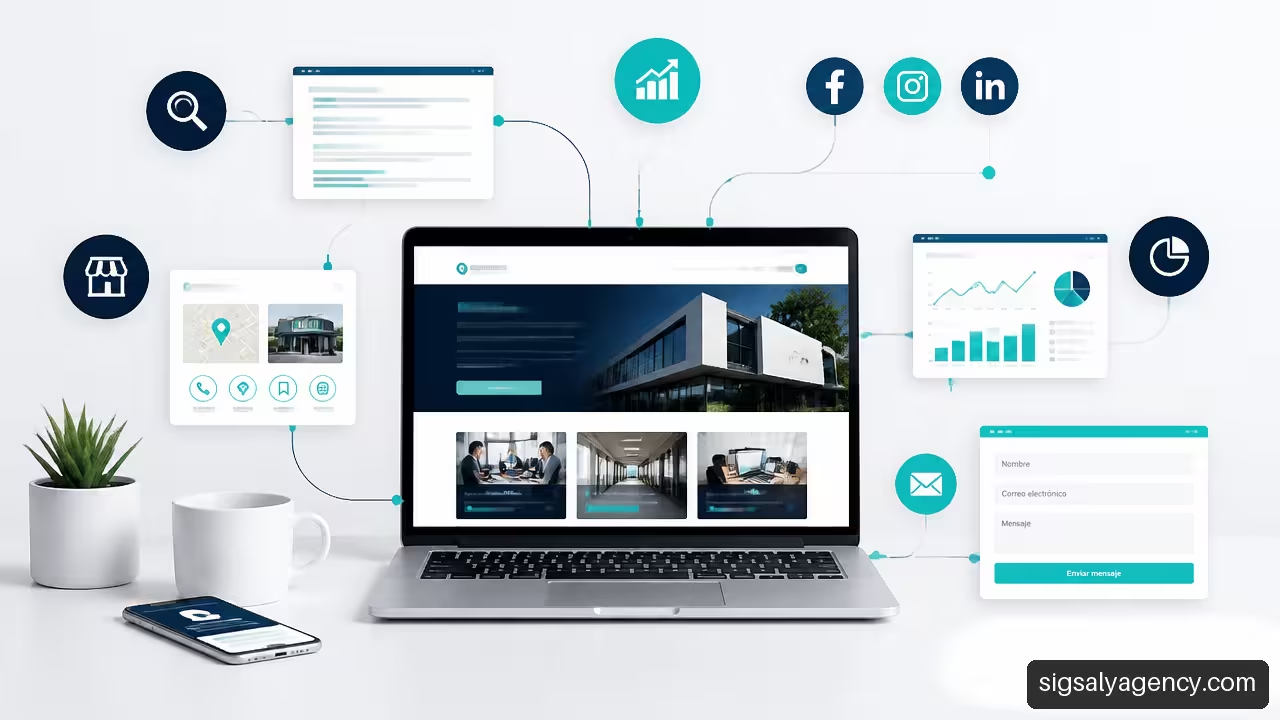
A professional digital presence is made up of interconnected assets, not isolated pieces. The website is usually the central hub because it's a space under the company's control. Social media, company profiles, campaigns, and directories can drive traffic to it, but they shouldn't completely replace it.
According to Connected Commerce and its information on basic internet presenceThe website functions as the digital face of the business, showcasing products or services and facilitating contact. This function seems basic, but it requires addressing specific aspects effectively: what is offered, for whom, where it is provided, how to contract it, and what happens after the initial contact.
Corporate Website, Landing Page or Online Store
The choice depends on the buying process, not on fashion or the available tool.
| Solution | When to Choose It | When to Avoid It as Your Only Asset | Essential Elements |
|---|---|---|---|
| Corporate website | Services, consultative selling, local businesses or B2B | If you only want to test a very specific, one-off campaign | Home, services, company, contact and local pages if applicable |
| Landing page | An offer, event, promotion, or campaign with a single objective | If the business needs to explain several services and build broad trust | Clear proposal, proof, form, and call to action |
| Online store | A purchasable catalog, defined logistics, and viable digital payment. | If each sale requires a technical quote or extensive negotiation | Product information, payment, terms and conditions, stock and after-sales service |
| Company profile | Local business with searches by area | If it is used to replace all proprietary commercial information | Correct information, hours, categories, photos, and responses to reviews |
A landing page can be effective for capturing inquiries about a specific service, such as an audit or a limited-time promotion. However, it doesn't necessarily replace the corporate website: those who arrive with questions about the company will look for its track record, reach, terms and conditions, and additional contact methods.
An online store shouldn't be launched simply because a catalog exists. If the price changes depending on dimensions, installation, volume, or customization, a store can complicate operations. In that case, a website with a simple configurator, a quote request form, or a sample request form might be a more realistic option.
The Minimum Structure That Should Resolve Doubts
Acelera Pyme establishes a minimum structure of sections, indexing requirements, and training for its basic web presence solution so that companies can modify elements of their site. These requirements are described in the Website solution and basic internet presence.
Beyond meeting a minimum structure, each page should address a user's intent. A reasonable architecture for many SMEs includes:
• Startwith a value proposition, core services, and a clear call to action.
• Service pages, one for each relevant line, with problem, scope, process and next step.
• Company page, focused on verifiable trust criteria, equipment where appropriate, working method and identifying data.
• Contactwith phone number, email, tested form, hours, service area and alternative support channels.
• Legal notices and privacyadapted to the activity and the personal data that is collected.
A generic services page may be sufficient initially if the business has a very simple offering. When there are several specialties or distinct target audiences, separating the pages helps to better explain the offering and makes it easier for each piece of content to address a specific search.
Branding, Content, and SEO Without Empty Promises
Branding isn't just about logos and colors. It includes tone, how services are named, the promises made, and consistency across websites, social media, and customer service. If a campaign promises a quick response and the form goes unanswered for days, the problem isn't design; it's operational.
In SEO, the initial work involves understanding how the audience describes their needs and reflecting that language in titles, headings, text, images, and internal links. Acelera Pyme indicates that an advanced presence includes basic positioning, keyword analysis, and on-page SEO. Information about Advanced Internet Presence specify these elements.
It's wise to manage expectations. Publishing a website makes it discoverable by search engines and users, but it doesn't guarantee rankings, traffic, or sales. The speed of progress depends on competition, relevance, technical quality, geographic reach, reputation, and the ability to create useful content. Therefore, before investing in advertising, it's reasonable to verify that the landing page clearly explains the offer and converts visits into leads.
To delve deeper into performance, accessibility, and structure, this may be helpful. strategic guide for professional web designAccessibility also improves the experience for people browsing from mobile devices, those with low vision, slow connections, or interaction difficulties.
Launch, Measure, and Maintain Your Online Presence
The launch is not the end of the project. It's the moment when real testing begins: users using mobile devices, forms submitted from different browsers, after-hours calls, and searches that may not match the expected ones.
Validate Before Publishing
A quick review can prevent mistakes that directly impact trust and lead generation. Before launching the website, I would check the following:
- The domain loads with a secure connection and displays the correct version of the site.
- Phone number, email, address, opening hours and social media links are correct.
- Forms, call buttons, bookings and payments work on mobile and computer.
- The main pages have a title, description, and headings that are easy to understand.
- There are no test texts, broken links, images without context, or empty pages.
- The analytics records agreed-upon conversions without inappropriately collecting personal data.
- There are backups, updates, and a procedure for recovering access.
This control is especially important when multiple providers are involved. Design, hosting, domain, email, analytics, and campaigns may all be on different accounts. If no one knows who controls each access, a provider change can lead to an avoidable disruption.
Maintaining Ownership of Assets
The SME should retain administrative control or verifiable access to critical elements. A technology provider can manage day-to-day operations, but ownership and recovery rights must be clearly defined in writing.
| Asset | The SME Must Control | You Can Manage a Supplier |
|---|---|---|
| Domain | Ownership, renewal and main access | Technical configuration |
| Hosting | Account, billing, and emergency access | Maintenance and safety |
| Web | Full copy, administrator users and content | Development and updates |
| Analytics | Account ownership and permissions | Configuration and reports |
| Social networks | Recovery email and administrators | Publishing and moderation |
| Digital advertising | Advertising account and agreed billing method | Campaign Management |
It's not about distrusting a supplier. It's about avoiding unnecessary dependence. It's also important to agree on who provides texts, images, legal information, customer responses, and approvals. If these responsibilities aren't defined, the project can be delayed even if the technical aspects are complete.
Measuring Conversions and Correcting the Course
Analytics must answer one simple question: What are the people who have value for the business doing? For an SME, conversions are usually more useful than raw traffic.
• Forms submitted and quality of the request.
• Clicks on phone, WhatsApp or email.
• Reservations, orders, document downloads or quote requests.
• Source of each contact: organic search, networks, campaign, referral or direct access.
• Business response time and contact outcome when it is possible to record it.
Data analysis is for prioritizing, not for filling out reports. If a page attracts a lot of visits but doesn't generate leads, there are several possibilities: wrong target audience, unclear messaging, weak call to action, long form, or poorly explained service. It's not advisable to change everything at once. It's better to modify one element at a time, observe, and document the results.
Once the base is working, a online marketing strategy It can coordinate content, SEO, advertising, and sales tracking. If the company is going to invest in campaigns, it's also helpful to review how landing pages, messaging, and lead generation relate to this resource. Professional web design, SEO and Google Ads.
Create a Realistic Maintenance Rhythm
A professional online presence requires maintenance, even if it's basic. You don't need to post daily or redesign your website every year. What you do need to do is prevent important information from becoming outdated.
A monthly routine might include reviewing forms, checking backups, updating software, responding to reviews, reviewing conversion metrics, and correcting outdated data. Each quarter, it's a good idea to evaluate which services generate the most interest, which pages need improvement, and what content can answer frequently asked customer questions.
Key Ideas
• Creating a professional digital presence for an SME starts with a specific business objective, not by choosing a social network or a template.
• The website is usually the central asset because it allows you to explain the offer, capture leads, and connect SEO, content, and campaigns.
• Corporate website, landing page, online store, and business profile serve different functions. Choosing the right ones avoids unnecessary investments.
• Ownership of the domain, hosting, analytics, and profiles must be documented and accessible to the company.
• Business conversions offer more useful insights than isolated visits or followers.
• Ongoing maintenance protects the initial investment and prevents a digital presence from appearing abandoned.
Frequently Asked Questions
What elements does an SME need to have a professional digital presence?
At a minimum, you need a clear value proposition, reliable contact information, a mobile-friendly website, a consistent visual identity, an active customer service channel, and a way to measure leads or sales. Then you can add SEO, social media, content, or advertising depending on your goals and your ability to maintain the business.
Is it better to start with a website or with social media?
In most cases, I would start with a simple, well-structured website, along with the appropriate business profile if the business operates locally. Social media is useful for distributing content and engaging in conversation, but it depends on external rules and requires constant activity. A website offers a dedicated space to explain what you offer and convert interest into contacts.
What type of website does my business need: Corporate, Landing Page, or Online Store?
Choose a corporate website if you sell services or need to build trust before contact. Use a landing page for a specific campaign or offer. Consider an online store when the catalog, payment, and delivery processes are well-defined and easy to manage. If each order requires technical analysis, a quote request form might be more suitable than a shopping cart.
How can I appear in Google search results when someone searches for my services?
First, ensure your website is indexable and that each service has clear content, relevant titles, and up-to-date contact information. For local businesses, maintaining consistent information in your business profile is also important. SEO requires ongoing effort, and there's no guaranteed timeframe, especially in competitive industries.
Which Social Networks Are Suitable for My Business?
Choose a network where your audience is and where you can regularly post and respond. A B2B company might prioritize professional channels; a visual retailer might need a platform focused on visuals; a local business might get more value from its business profile and messaging than from posting frequent videos. Avoid creating profiles you can't maintain.
How do I know if a social network is generating clients for me?
Don't just focus on reach or followers. Use identifiable links to your website, and record messages, calls, bookings, and forms from that channel. Then, review how many contacts convert into actual leads. If a network generates interaction but no sales conversations, it might be useful for brand awareness, but it shouldn't be considered a direct lead generation channel.
What Should My Company Control and What Can a Supplier Manage?
The company must retain ownership and recovery access to the domain, hosting, analytics, social media profiles, and advertising accounts. A vendor can handle design, maintenance, SEO, content, or campaigns. The important thing is to agree on permissions, deliverables, backups, training, and exit procedures before starting work.
What Should I Do After Publishing the Website?
Check that forms and calls are working, measure conversions, update content, and respond quickly to inquiries. During the first few weeks, observe which pages receive visits and what questions arise. This information allows you to improve messaging, calls to action, and structure without having to redesign the entire site.
Sources and References
- Connected Commerce + Digital Kit – Help for website and basic online presence: https://comercioconectado.gob.es/es-es/Impulsa/Paginas/kit-digital-ayuda-sitio-web-presencia-basica-en-internet.aspx
- Accelerate SMEs + Advanced Internet Presence: https://www.acelerapyme.gob.es/kit-digital/presencia-avanzada-en-internet
- Accelerate your SME + Website and basic Internet presence: https://www.acelerapyme.gob.es/kit-digital/sitio-web
- Accelerate SMEs + Guide to creating a digitization plan for your SME: https://www.acelerapyme.gob.es/novedades/pildora/guia-para-crear-un-plan-de-digitalizacion-para-tu-pyme
- Chamber of Commerce + Spain Digital Business Guide: https://empresadigital.camara.es/sites/default/files/publications/guia_espana_empresa_digital_1.pdf