A web agency for entrepreneur's personal brand You can transform professional experience, a business idea, or a specialized service into a clear and ready-to-capture digital presence. It's not just about publishing an engaging bio: your website should explain what problem you solve, for whom, why your approach deserves attention, and what the next step is to contact you.
A personal brand doesn't require becoming an influencer or sharing every aspect of your private life. You can build a professional identity centered on an offering, a methodology, and a reputation. In fact, A professional brand can be developed without requiring an influencer identity., a useful distinction for consultants, therapists, trainers, creatives and specialists who prefer to communicate with defined boundaries.
Table of Contents
- What Should a Web Agency Solve?
- How to Choose the Right Type of Website
- What Should the Project Include Before Designing
- How to Evaluate Project Quality and Ownership
- Key Takeaways
- Frequently Asked Questions
What Should a Web Agency Solve?
A good agency doesn't start by asking what colors you like. First, it should help you organize your business strategy: what you sell, to whom, when they need you, and what action you want a visitor to take. Design comes later as a way to make that strategy visible.
Translate Your Experience into an Understandable Offer
Personal branding often fails when it's presented as a lengthy resume. Having experience doesn't equate to having a value proposition. A website needs to bridge the gap between what you can do and what the visitor understands in just a few seconds.
For example, “I help companies grow” is too broad. In contrast, “I help professional firms streamline their digital lead generation through local SEO and content” identifies a specific audience, a problem, and a specific approach. The initial phrase might change after an analysis phase, but it must exist before writing a homepage.
A web agency should work on, at a minimum, these elements:
• Positioning: the professional category and the space you wish to occupy.
• Priority customer: not all audiences at once, but the group with the greatest commercial fit.
• Main problem: a specific need that your service can solve.
• Offer and scope: what the service includes, what result it seeks, and what its limitations are.
• Trust proofs: verifiable cases, authorized testimonies, publications, certifications, or work samples.
• Call to action: book, request information, download a resource, or sign up for a list.
A useful personal branding website doesn't seek admiration. It facilitates a decision: "I understand what this person does, I see if I fit in, and I know how to move forward."
Some proposals from the sector combine design, structure, narrative authority, and engagement. For example, Blackhold Consulting's approach for consultants and entrepreneurs integrates design, storytelling, and lead generation.The practical implication is relevant: personal history only adds value if it clarifies the offer and reduces doubts, not if it occupies the space that should explain the service.
Design a Journey, Not a Collection of Pages
A website doesn't work like a static brochure. Each section should answer a question that the visitor asks almost automatically:
| Visitor Question | The Answer the Website Should Give | Recommended Item |
|---|---|---|
| Is this for me? | Audience and problem addressed | Homepage headline |
| What solution does it offer? | Services and deliverables | Services page |
| Why should I trust him? | Method, demonstrable experience and evidence | Cases, testimonies and process |
| What do I have to do now? | Clear and simple action | Reservation, form or contact |
This journey needs to work especially well on mobile. If someone arrives from LinkedIn, Instagram, an interview, or a referral, they might not read everything. They need to quickly find the offer, a sign of credibility, and a simple action.
At this point, content, structure, and visibility are intertwined. A project by Professional web design and SEO It can help ensure your website architecture meets both user needs and searches related to your services. However, it's best to avoid making promises about specific rankings: SEO depends on competition, search intent, content quality, domain authority, and consistent effort.
Connect Channels Without Relying On Them
Social media can attract attention, but it shouldn't be the only place your business exists. An account can change its rules, limit its reach, or lose visibility. Your website is the space where you organize your message, contacts, and resources.
A personal branding website can connect social media, newsletters, and service bookings.As Azuanet points out in its proposal for entrepreneurs, the key is not to link all profiles by default, but to define the function of each channel. LinkedIn can demonstrate professional expertise; a newsletter can nurture relationships; a calendar can facilitate bookings; the website should bring these elements together without overwhelming the visitor.
How to Choose the Right Type of Website
Not every personal brand needs a full website from day one. Choosing more pages than necessary can delay the launch; choosing too few can make it difficult to explain a complex offer. My recommendation is to decide based on the maturity of the business, not on trends or a pre-designed template.
Landing Page, Services Website or Advanced Lead Generation
| Format | Suitable When | It May Fall Short When | Main Objective |
|---|---|---|---|
| Landing page | You have a core offering, a defined audience, and you need to validate interest. | Do you offer multiple services or do you need in-depth SEO work? | Get conversations or bookings |
| Services website | You already have a stable offer and several reasons to trust it. | You still don't know which service you want to prioritize | Explain, qualify, and capture contacts |
| Website with advanced lead generation | You publish content, manage resources, events, or multiple conversion paths | There is no capacity to maintain content and automations | Build audience and recurring opportunities |
A landing page can be a reasonable first step if the goal is to facilitate conversations with potential customers. Agency 321 presents the landing page as a first site aimed at starting conversations.It's a useful option, for example, for a consultancy that offers a single strategy session and wants to check if the proposal generates inquiries before expanding the website.
Avoid it if you have three distinct service lines, need to address common objections, or want to attract organic traffic for multiple searches. In those cases, a service website offers space to separate audiences, explain processes, and build pages that cater to different intents.
Personal Branding and Commercial Branding Are Not the Same
A personal brand puts the individual at the center of public perception. A business brand may have the founder as its spokesperson, but allows the company to gain autonomy. Both approaches can coexist.
Imagine a psychologist offering individual sessions under her own name. Her authority, communication style, and specialization are central to the decision. A personal brand makes sense. However, if that professional plans to build a team, courses, and a community with various specialists, a business brand might be more suitable, where her name appears as the founder but isn't the only visible asset.
The agency should make this decision before designing the logo and domain. Changing the name, service structure, or the relationship between brand and person once the site is already built usually increases costs and confusion.
Platform: Decide by Operation, Not by Aesthetic Preference
There's no single perfect platform for every personal brand. WordPress is often a common choice when editorial control, SEO, forms, blogging, and functional updates are required. Other tools might be a better fit for smaller sites with limited needs. The key is to assess who will be updating the website, how dependent you'll be on a single provider, and what integrations you need.
Before accepting a technical recommendation, ask for a clear answer to these questions:
- Will I be able to edit basic texts, services, and pages without interfering with the code?
- What happens if I need to migrate the website to another provider?
- What external tools will connect and who will control their accounts?
- What technical maintenance does the chosen solution require?
- How will backups, updates, and restores be performed?
Technology should serve the business. If a visually sophisticated website requires costly changes every month just to update a single phrase, it's not effectively supporting the operations of an evolving brand.
What Should the Project Include Before Designing
The quality of the outcome depends largely on preparation. An agency can provide guidance and organize materials, but it shouldn't fabricate credentials, results, or testimonials. When evidence is lacking, it's best to honestly explain the approach, methodology, and type of problem being addressed.
The Assets That Should Be Prepared
Before starting the design, I suggest you put together a simple dossier. It doesn't have to be perfect. Its purpose is to prevent essential decisions from being made hastily at the end of the project.
• Description of services, packages or contracting methods.
• List of clients or sectors you want to target, if relevant to communicate it.
• Brief professional biography, with relevant and verifiable milestones.
• Testimonies with authorization and sufficient context to be credible.
• Professional photographs or a realistic plan to obtain them.
• Frequently asked questions and objections that arise in business conversations.
• Existing downloadable resources, articles, interviews, or work samples.
• Contact information, booking calendar and basic privacy conditions.
For example, a trainer without publicly available case studies can temporarily compensate for this by creating a page that explains their curriculum, methodology, verifiable experience, and an introductory session. What they shouldn't do is fill the website with generic testimonials or figures devoid of context.
The Brief That Prevents a Beautiful But Useless Design
The brief is not an administrative form. It's the document that allows you to evaluate whether the visual proposal aligns with the business. It should include objectives, target audiences, tone, references, functionalities, and criteria for project approval.
It is also necessary to define what is not It will be done. If the budget covers design and development, but not photo shoots, extensive copywriting, email automation, or content creation, this must be stated in writing. Ambiguity is a common source of delays.
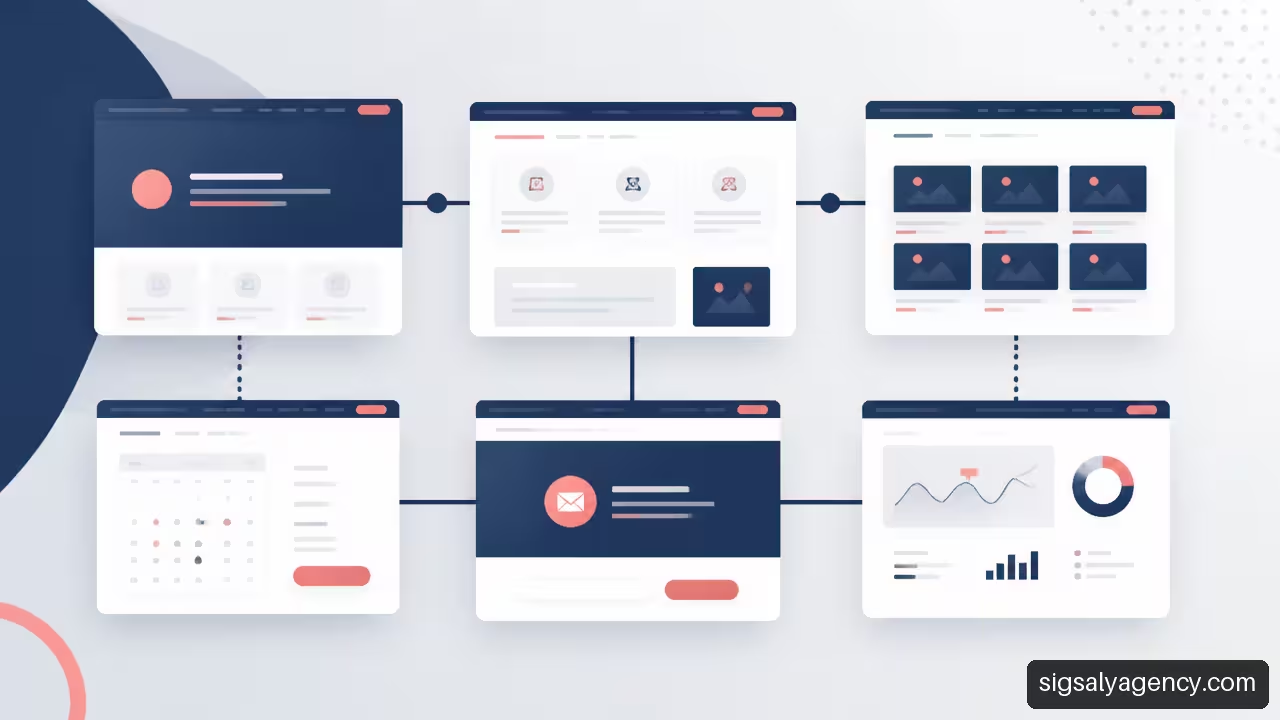
A reasonable workflow usually follows this sequence:
- Definition of positioning, offer, objectives and priority audience.
- Information architecture and page map.
- Drafting essential messages and gathering evidence.
- Visual design of the main templates.
- Development, form configuration and mobile adaptation.
- Technical review, publication, measurement and maintenance plan.
SEO, Content, and Conversion Must Arrive Before Launch
SEO isn't about repeating keywords. For a personal brand, it starts with understanding how your audience phrases their needs. A tax advisor can create content about specific obligations; a nutritionist can create pages about services and specialties; a photographer can target local searches and searches by session type.
The integration between Web design and online marketing It's useful when a website needs to coordinate content, lead generation, campaigns, and analytics. However, it's not advisable to create a blog just to "publish something." If there's no editorial capacity, it's better to launch a few solid pages and update them when services, questions, or the market change.
Conversion also requires tracking. A form isn't enough if no one responds or if there's no record of what happened. The agency can set up events to measure submissions, phone clicks, bookings, or downloads. After launch, this data helps identify problems: high traffic with few requests can indicate an unclear message, a poorly matched offer, or an inconspicuous call to action.
How to Evaluate Project Quality and Ownership
A web agency is evaluated as much by what it delivers as by how clearly it explains its limits, responsibilities, and maintenance. The goal isn't to demand impossible promises; it's to turn concepts like "professional," "fast," or "results-oriented" into verifiable conditions.
Acceptance Criteria You Can Review
Before approving the publication, review these areas with specific examples:
| Area | What to Check | Warning Sign |
|---|---|---|
| Message | The service and the public are understood on the first screen. | Vague headlines focused only on the person |
| Mobile | Text, buttons, and forms work on small screens | Difficult menus, small buttons, or cut-off content |
| Contact | Every action goes to an account controlled by you. | Forms that depend on a third-party email address |
| Accessibility | Legible contrast, clear structure, and alternative text in key images | Information conveyed only through color or images with text |
| Performance | The main pages load reasonably well with a normal mobile connection | Large videos or decorative elements that block the content |
| Measurement | Important events and access to analytics are defined. | Data visible only to the agency |
There's no universal figure that guarantees conversions. They depend on the offer, the price, the traffic source, and prior trust. That's why it's more useful to agree on key performance indicators (KPIs) and a review period than to promise an exact return. For example, during the first few weeks, you can compare which pages receive visits, how many people start a booking, and where they abandon the process.
Domain, Accounts and Portability
This point deserves special attention. The domain, hosting, analytics tool, email provider, advertising accounts, and newsletter lists are operational assets. They must be registered in the name of the entrepreneur or their company, with clear and recoverable access.
Request that the contract state:
• Ownership of the domain and the published content.
• Administrative access to hosting, CMS, analytics, forms, and email.
• Delivery of files, databases and credentials upon project closure.
• Licenses for third-party themes, extensions, fonts, images, and resources.
• Migration procedure if you change providers.
• Scope and cost of subsequent maintenance.
Fair warning: An agency technically managing these elements is not the same as owning them. This dependency may be reasonable during support, but it shouldn't prevent you from recovering your website or data.
Editorial Maintenance Is Also Part of the Business
A personal brand evolves: new services are added, a specialty is redefined, case studies are published, or the booking process is modified. If the website isn't updated, it ends up describing an outdated version of the business.
Maintenance involves two layers. The technical layer covers security, updates, backups, and incident reporting. The editorial layer updates messages, services, case studies, photos, content, and calls to action. Both are important. A technically secure page can still miss opportunities if it displays an expired offer.
To understand this operational dimension, consult Website maintenance and digital successIt's advisable to establish a simple routine, for example, reviewing services, forms, and high-traffic pages every quarter. If the business is undergoing a period of change, this frequency will need to be increased.
Key Takeaways
• A web agency for an entrepreneur's personal brand should first prioritize the value proposition, the target audience, and the conversion; visual design comes later.
• A landing page is suitable for a simple and verifiable offer. A services website is more appropriate if there are multiple lines of business, objections, or SEO needs.
• Personal branding doesn't require constant exposure. It can be a professional identity with clear boundaries and a specific offering.
• Domain, analytics, content, and lead generation accounts must remain under your control or with guaranteed administrative access.
• The launch is not the end of the project: measuring forms, bookings and tours helps to identify what needs improvement.
• Editorial maintenance is as necessary as technical maintenance when services, positioning, or trust tests evolve.
Frequently Asked Questions
What Exactly Does a Web Agency for Entrepreneurial Personal Branding Do?
It defines or clarifies positioning, organizes website architecture, designs pages, develops functionalities, connects lead generation channels, and can support SEO, branding, and measurement. The actual scope depends on the contract: it's advisable to confirm what's included in copywriting, photography, visual identity, automation, and maintenance.
Do I need a landing page or a complete website to get started?
Choose a landing page if you have a main offer, a clear target audience, and a specific action, such as booking a call. Choose a full website if you offer multiple services, need to demonstrate methodology and experience, or want to target various organic search results. Don't expand your site for appearance; do so only when the complexity of your business warrants it.
What Pages Should a Personal Brand Website Have?
As a starting point, a homepage, services page, a page about professional approach, contact information, and privacy policy are usually helpful. Depending on the business, you might add case studies, resources, a blog, FAQs, or a booking page. Each page should have a purpose; a section without a clear objective can be distracting.
How do I demonstrate experience if I don't have many clients yet?
Don't fabricate results or use vague evidence. You can explain your expertise, verifiable training, methodology, your own projects, work samples, or public analyses. You can also offer a more focused initial proposal to obtain the first real validations and update the website when authoritative testimonials are available.
Can the Agency Create My Naming, Logo and Visual Identity?
Yes, many agencies combine branding and web design, but you should confirm the scope. Naming, research, brand strategy, logo, visual identity, and user guide are all distinct deliverables. Ask for details on which versions will be delivered, what usage rights you'll have, and how the identity will be applied across the website.
What Should I Measure After Publishing the Website?
Measure qualified visits, landing pages, form submissions, bookings, phone or email clicks, subscriptions, and traffic sources. Then interpret the context. Ten irrelevant inquiries don't have the same value as two well-qualified leads. Define what constitutes a valid opportunity before evaluating results.
Who Should Own the Domain and Accounts?
The entrepreneur or company must control the domain and have administrative access to hosting, analytics, email, forms, newsletters, and campaigns. The agency can operate these tools, but it must be clear how to recover access, files, and data if the relationship ends.
Sources/References
• Blackhold Consulting — Personal Branding Websites for Consultants and Entrepreneurs: https://www.blackholdconsulting.com/desarrollo-web/webs-de-marca-personal/
• Azuanet — Web design for entrepreneurs: https://azuanet.es/diseno-web-para-emprendedores
• Agency 321 — Website design for entrepreneurs: https://www.agencia321.com/
• Branding Makers — Branding for entrepreneurial professionals: https://brandingmakers.es/branding/profesionales-que-emprenden