
Creating a website for local business aimed at attracting nearby customers requires going beyond a simple corporate presentation. When users in your city or neighbourhood search for urgent services, professional consultations or nearby establishments, they expect to find direct answers, verifiable contact details and quick ways to interact. In this article I analyse how to design and optimise your website so that it not only captures traffic from search engines and maps, but converts those visits into actual calls, appointments or sales.
Table of Contents
- Key Points on Local Web
- Architecture of a Web Page for Local Business Focused on Attracting Nearby Customers
• The Approach Oriented to Main Commercial Action
• Separation between Local Discovery and Web Conversion
• Structure for Businesses with Physical Location vs. Service Area Businesses - Local Content and Social Proof: Demonstrating Real Coverage
• Hyperlocal Pages without Falling into Duplicate Content
• Integration of Reviews, Case Studies and Area Photographs
• NAP Consistency: Name, Address and Phone Number Synchronised - LocalBusiness Structured Data and Technical Optimisation
• Correct Configuration of LocalBusiness Schema Markup
• Validation and Technical Accessibility of Markup
• Operational Limits of Rich Results - Measurement and Exact Attribution of Nearby Traffic
• UTM Tagging for Google Business Profiles and Maps
• Capture and Tracking of Calls, Forms and Bookings
• Evaluation of Local Conversion Metrics - Continuous Maintenance Plan for Local Business
• Management of Operational Events, Special Hours and Holidays
• Update Protocol after Location or Services Changes
• Periodic Audits of Business Consistency - Frequently Asked Questions on Local Web
- Sources and References
Key Points on Local Web
• Priority conversion comes firstThe design must be structured based on the immediate commercial objective of the nearby user (call, book, request a quote or reach the physical establishment).
• Complementarity with Google Maps: The Business Profile serves as a proximity discovery channel, while the website expands the information and closes the purchase decision.
• Differentiation according to the operating model: Service area businesses (home delivery) require a landing page architecture very different from that of a commercial premises with face-to-face service.
• Evidence of real work: To avoid penalties or lack of interest in location pages, it is essential to provide tangible proof of the service provided in that specific area.
• Rigorous technical validation: Structured data does not guarantee prominent positions by themselves, but they facilitate algorithmic understanding if they do not suffer from crawl blocks or syntax errors.
Architecture of a Web Page for Local Business Focused on Attracting Nearby Customers
Designing a website for local business aimed at attracting nearby customers requires prioritising user proximity intent. Unlike a national portal or massive e-commerce, someone looking for a nearby business values immediacy, operational clarity and geographic trust.
The Approach Oriented to Main Commercial Action
The first mistake many small businesses make is building a generic homepage with overloaded menus. In local acquisition, we recommend defining a single main commercial action according to the nature of the sector:
- Emergency services (locksmiths, plumbers, tow trucks): The absolute priority is the direct call button from mobile devices.
- Services by appointment (clinics, hairdressers, consultancies): The design axis should be the appointment booking widget or the quick form.
- Shops and restaurants with physical premises: The focus is on the location map, directions to get there and the advertised business hours of the day.
- Prior quote services (renovations, air conditioning installation): The structure should lead to a simplified cost estimate request form.
By aligning the architecture with direct conversion, we reduce the visitor's cognitive friction and increase the response rate.
Separation between Local Discovery and Web Conversion
There is a conceptual distinction between local discovery and web conversion. Map platforms and knowledge panels allow brand discovery when the user searches for a geolocated term. However, verifying the business profile allows you to manage business information in Google Search and Maps, which constitutes the first point of digital contact.
The official website should not compete by duplicating the same simplified function of the Google Maps profile. Its role is to provide detailed information that the external profile does not allow to structure: methodical breakdown of fees, working methodologies, quality certificates, complete project catalogue and contractual guarantees.
Structure for Businesses with Physical Location vs. Service Area Businesses
Not all businesses operate the same way. Web architecture should reflect whether the customer visits the establishment or whether the company travels to the client's home.
| Design Criterion | Business with Physical Establishment | Service Area Business (Home Service) |
|---|---|---|
| Main Element in Header | Complete physical address and 'Get directions' button. | Quick assistance phone and service areas. |
| Address Visibility | Mandatory in footer, contact and header. | Optional or absent if not served at the headquarters. |
| Coverage Pages | Focused on the neighbourhood or municipality of the location. | Specific landing pages by municipality or province. |
| Commercial Action | In-person visit or advance appointment booking. | Request for site visit or online quote. |
| Key Social Proof | Photos of the facilities and on-site team. | Photos of completed projects on site in the area. |
Local Content and Social Proof: Demonstrating Real Coverage
The content of a local website should reflect real experience on the ground. Publishing identical texts changing only the city name usually proves ineffective and damages the corporate image.
Hyperlocal Pages without Falling into Duplicate Content
To position across multiple nearby geographic areas without creating massive low-quality pages, we suggest a framework based on real intervention data:
• Local projects detail: Rather than writing a generic text, it is advisable to detail actual interventions, indicating the district or municipality, the client's problem and the solution applied.
• Urban and geographical references: Mentioning recognisable elements of the area (main avenues, industrial estates or landmarks) helps to contextualise the company's activity.
• Geolocated testimonials: Include comments from customers who expressly identify their place of residence or work.
• Original images of the surroundings: Avoid generic stock photographs and replace them with real images of the team working in that location.
Integration of Reviews, Case Studies and Area Photographs
Social proof is a critical driver of local conversion. Integrating customer ratings through widgets connectable with review platforms helps mitigate the uncertainty of the new buyer.
A nearby customer seeks guarantees before allowing a technician into their home or before driving 20 minutes to an unfamiliar business.
Presenting a dynamic module with real ratings and photographs of completed work in the user's vicinity consolidates commercial credibility immediately.
NAP Consistency: Name, Address and Phone Number Synchronised
The NAP concept (Name, Address, Phone) requires that the company's public data be identical across all digital platforms. If a telephone number or address appears on the website that is slightly different from that registered in business directories or on map listings, search engines may experience difficulties validating the business entity.
We recommend carrying out systematic reviews to ensure that the company name or trading name, the street with its precise number and the postal code match character by character in the footer of the website and on any external platform where the business maintains a presence.
LocalBusiness Structured Data and Technical Optimisation
The technical implementation of semantic markup enables tracking tools to process business operational information unambiguously.
Correct Configuration of LocalBusiness Schema Markup
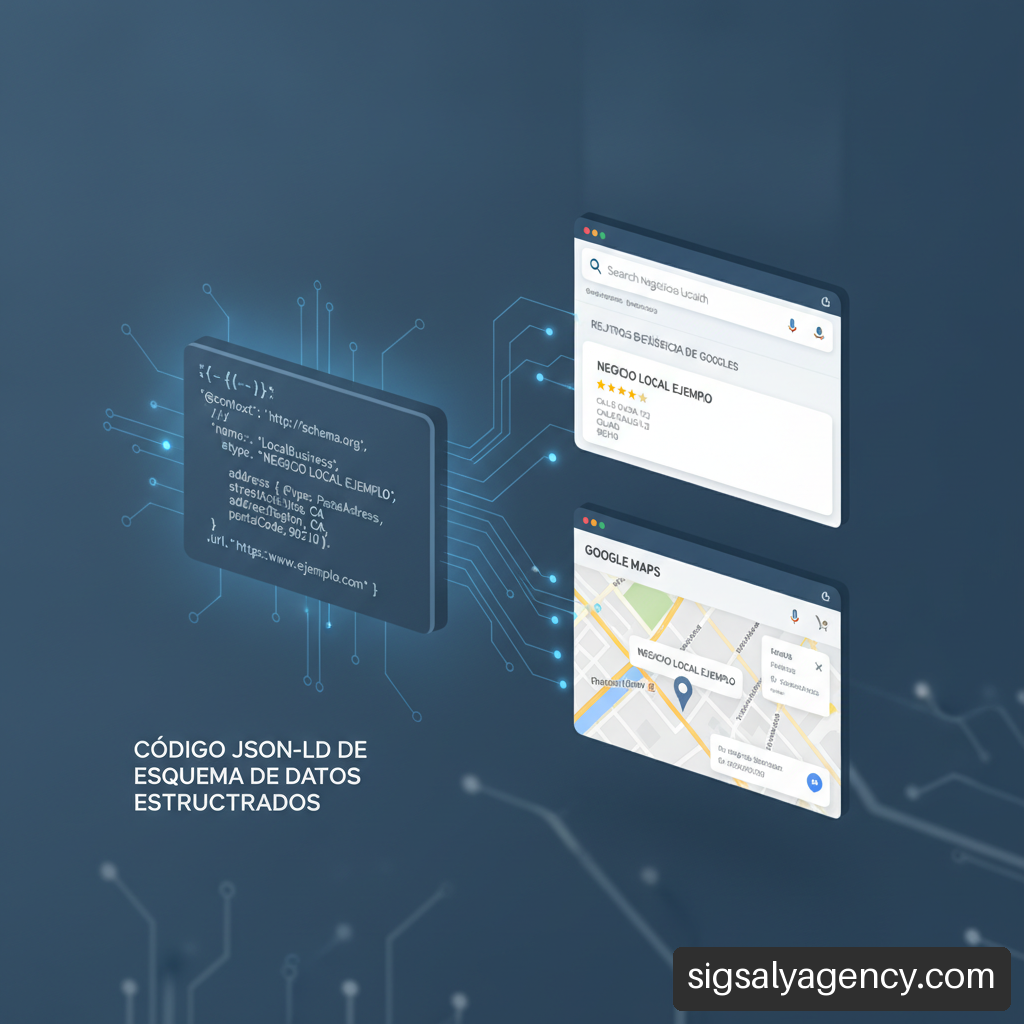
The schema LocalBusiness from Schema.org specifies the type of activity, opening hours, geographical coordinates and direct contact details.
{
"@context": "https://schema.org",
"@type": "LocalBusiness",
"name": "Example Local Services",
"image": "https://example.com/logo.jpg",
"telephone": "+34912345678",
"address": {
"@type": "PostalAddress",
"streetAddress": "Calle Mayor 12",
"addressLocality": "Madrid",
"postalCode": "28001",
"addressCountry": "ES"
},
"geo": {
"@type": "GeoCoordinates",
"latitude": 40.416775,
"longitude": -3.703790
},
"url": "https://example.com",
"openingHoursSpecification": {
"@type": "OpeningHoursSpecification",
"dayOfWeek": [
"Monday",
"Tuesday",
"Wednesday",
"Thursday",
"Friday"
],
"opens": "09:00",
"closes": "18:00"
}
}
The documentation recommends specifying a main telephone number and using country and area codes where appropriate", ensuring that search engines recognise the dialling format without errors.
Validation and Technical Accessibility of Markup
It is essential to check that the JSON-LD code embedded in the header or footer of the website is free of syntax errors. In accordance with search engine development guidelines, local markup must follow guidelines, be validated and be accessible to Google. This means that crawl instruction files such as robots.txt or the tag noindex must not block URLs where semantic markup is implemented.
Official tools such as the Rich Results Test (Rich Results Test) and URL Inspection in the search console allow you to verify whether the code is interpreted correctly before its final deployment.
Operational Limits of Rich Results
There is a widespread misconception that adding semantic markup automatically positions the website on the first pages of results. It is worth clarifying that Google uses structured data to understand content, but eligibility does not guarantee appearance in enriched formats.
Semantic markup acts as a facilitator of syntactic understanding; the actual organic position will depend on factors such as thematic relevance, business prominence, loading performance and overall user experience.
Measurement and Exact Attribution of Nearby Traffic
Investing in a website for local business aimed at attracting nearby customers requires clear analytics systems that differentiate web interactions from requests generated by corporate listings on map platforms.
UTM Tagging for Google Business Profiles and Maps
When a user clicks on the website link from the map listing, the web analytics system can record that visit as standard organic or direct traffic. To isolate the actual volume of traffic generated by map discovery, it is advisable to add URL tagging parameters to the destination URL:
By applying this nomenclature, the web analytics tool will allow you to filter exactly how many sessions, calls or converted forms were initiated from the map profile.
Capture and Tracking of Calls, Forms and Bookings
A high percentage of local traffic interacts through mobile phone calls. To capture this data accurately in analytics, we suggest configuring click events on quick dial links (href="tel:+34...").
| Contact Channel | Recommended Measurement Event | Key Performance Metrics |
|---|---|---|
| Phone Call | Link click tel: / Dynamic call tracking. | Call duration, time and conversion rate. |
| Contact Form | Successful form submission (Thank You Page). | Cost per lead and completion rate. |
| Online Booking | Final confirmation in the booking engine. | Average booking value and source channel. |
| Directions Route | Click on the 'Get directions' button or map link. | Direct in-person visit intention. |
Evaluation of Local Conversion Metrics
Evaluating the performance of a local website based solely on absolute user volume is an incomplete analysis. A site focused on a specific community may receive fewer visits than a digital magazine, but record a significantly higher commercial conversion rate.
Priority metrics should focus on the number of qualified contacts received from the coverage radius defined by the company, discarding traffic outside the geographical service area.
Continuous Maintenance Plan for Local Business
A local web presence is not a static project. Operational changes in the company must be immediately transferred to the digital environment to avoid frustrating the user experience.
Management of Operational Events, Special Hours and Holidays
The unexpected closure of an establishment during a public holiday not communicated on the web or in associated listings generates customer dissatisfaction. We recommend synchronising operational information during specific periods:
- Holidays and festivities: Modify the schedule on the homepage and update the attributes of the semantic markup
openingHoursSpecificationin advance. - On-call or emergency services: Enable a prominent notice in the top bar of the site indicating availability or special emergency rates.
- Temporary closures for works: Publish a clear statement specifying the estimated reopening date and alternative service channels.
Update Protocol after Location or Services Changes
In the event of relocation to a new premises or modification of the main telephone number, we recommend executing an orderly update protocol:
• Step 1: Update contact details in the footer, contact page and legal notice of the official website.
• Step 2: Modify the properties of the structured data schema LocalBusiness.
• Step 3: Request the update of address and telephone number in the corporate profile on Google Maps.
• Step 4: Review and correct information in sector directories and secondary local databases.
• Step 5: Implement 301 redirects if the URLs of service or location pages have changed structure.
Periodic Audits of Business Consistency
It is advisable to carry out quarterly audits to verify that there are no discrepancies between the company's actual offerings and the information published on the website. Testing contact forms from mobile devices, verifying that call links work correctly and ensuring that the ratings shown are up to date are essential operational tasks to maintain the rate of local customer acquisition.
Frequently Asked Questions on Local Web
What must a website for local business necessarily include?
A website aimed at local clients must clearly display the value proposition at first glance, a visible contact or call button on mobile devices, physical address or coverage areas well explained, updated opening hours, structured local business data and testimonials or real photographs of its activity in the area.
Is it preferable to have a single page or create pages by service and location?
For businesses that operate a single establishment in a specific municipality, a compact structure with a few well-optimised pages is usually the most agile option. However, if you provide services across multiple adjacent municipalities, it is advisable to create specific landing pages for each service area, as long as you incorporate real information and projects from each zone to provide genuine value to the user.
How is the website connected to the Business Profile on Google Maps?
The connection is made by linking the website URL or the specific contact page from the corporate profile card. To accurately measure traffic generated from map searches, it is highly recommended to add UTM tracking parameters to the business profile link.
What is the difference between appearing on Google Maps and ranking the website?
Google Maps displays business profiles based primarily on the geographic proximity of the user, category relevance and profile prominence. Meanwhile, the website appears in traditional organic search results thanks to its detailed content, technical architecture, links and search engine optimisation. Both channels are complementary and reinforce each other.
How do I optimise the website if my business provides services at home and has no physical premises open to the public?
If you operate as a service area business (for example, locksmith or plumbing services at home), it is not necessary to publish a physical address for public attention. You should focus the page on precisely defining the range of municipalities served, include testimonials of interventions in each area and provide emergency contact routes through call buttons or quick quotes.
Does structured data markup guarantee top rankings?
No. Semantic markup LocalBusiness facilitates search engines to correctly process and interpret the company's operational information. Although it improves eligibility for displaying rich results or complete information cards, organic positioning depends on a sum of factors that include thematic relevance and site authority.
How do I prevent pages by municipality from appearing as duplicate content?
To avoid penalties for low-quality content or automated duplication, avoid limiting yourself to copying the same text by changing the municipality name. Add value by including original photos of work carried out in that area, opinions from local customers, details about regulations or urban particularities of the municipality and case studies specific to the locality.
Sources and References
• Google Search Central: Documentation on structured data for local business
• Google Search Central: Guide to adding business information in Google
• Google Search Central: Rich results gallery and supported structured data
• Google Search Central: Structured data specifications for organisations